
Curtains in Hyderabad
Measured, made and hung by the people who sold them to you
Curtains are the one thing in a room that moves, and the one most often got wrong — hung too low, too narrow, or on a track that fights the ceiling. We measure the window, not the drawing.
What we make
Light passes through, the room stays private in daylight.
best for living rooms that face a garden or a quiet road
The weave is open enough that daylight still fills the room, and close enough that nobody outside sees in clearly. It is the gentlest layer — privacy without darkness.
Cuts most of the light without going fully dark.
best for bedrooms where you still want to know it’s morning
Enough light is stopped that the room feels calm, but not so much that you lose the sense of day. It sits between a sheer and a true blackout.
A lining that stops light rather than just softening it. On a tall drop, ask for wide-width fabric — it avoids a horizontal seam, and a seam is exactly where light gets through.
best for nurseries, shift workers, west-facing bedrooms
The lining is dense enough that no daylight comes through the cloth itself. The only places light can enter are the edges and any seams, which is why we prefer wide-width fabric on a tall window.
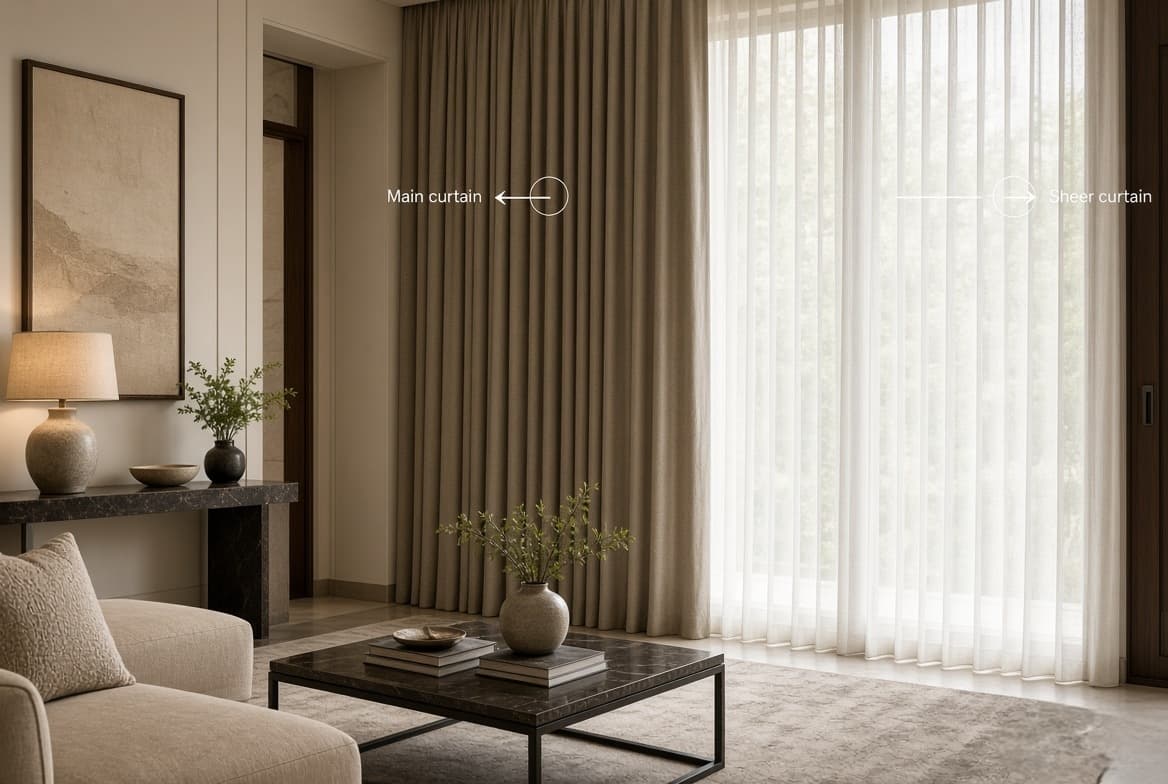
Two tracks, two fabrics. Sheer by day, the heavy pair drawn at night.
best for ground-floor and road-facing rooms
By day the sheer hangs alone and the room stays bright and private. At night the heavier curtain is drawn across the same window. One window, two behaviours.
Structured folds that hold their shape when drawn back.
best for formal living rooms, dining rooms, and tall windows that need a tailored finish
The fabric is gathered into even groups at the heading. A pinch pleat is not a curtain you simply hang — it is one shaped at the top, so the folds stay crisp from rod to floor.
Simple deep waves on a visible rod. Fewer parts, less cost.
best for bedrooms, and rooms where they are opened and closed every day
The rod passes straight through the rings, with no hooks and no tape. The fabric falls in soft, even columns, and sliding them apart moves the whole panel at once.
Even, continuous curves on a concealed track.
best for long unbroken runs and minimal rooms
Carriers on the track hold the fabric in a repeating wave. Open, the waves compress into a tight stack; drawn, they keep the same shape and simply sit farther apart.
Which one do you need?
“There’s no pelmet, so the track will be on show”
Two ways. Either recess the track into a pocket in the false ceiling so nothing is visible at all, or choose a rod meant to be seen and treat it as part of the room. The mistake is a plain white track left exposed — it reads as unfinished because it is.
“The window goes right up to the ceiling”
Ceiling-mounted track. It needs no headroom above the window, and hanging from the ceiling makes the wall read taller than it is.
“Two windows with almost no wall between them”
One continuous track across both, with the curtains stacking at the outer edges only. Treating them as two separate windows leaves a bunched column of fabric in the middle and blocks the light.
“I want it dark for sleeping but not gloomy in the day”
Blackout lining behind a sheer, on a double track. You draw what you need. A single blackout curtain means the room is either fully shut or fully open, which is why people stop using them.
“It’s the ground floor and people walk past”
Day-night layering. Sheers hold privacy in daylight without killing the light; the outer pair closes after dark.
“The wall is hollow or the plaster is weak”
Fix to the ceiling slab instead. A heavy pair of curtains on a poorly-anchored wall bracket comes down eventually, usually taking the plaster with it.
“Another quote is half the price. What am I missing?”
Almost always the panel count, and the lining. Curtains are quoted by the panel, and a panel is roughly one width of fabric — so fewer panels means less fabric gathered across the same window. It hangs flat, and it looks thin the moment you draw it. Ask both quotes how many panels per window and what lining is behind them. Two quotes that differ by half are usually not quoting the same curtain at all.
“The run is very wide and the fabric is heavy”
A corded or motorised track, split at the centre. Past a certain weight, dragging fabric by hand wears the leading edge and pulls the heading out of shape.
Talk it through
Measurements are the part most people get wrong, and a wrong measurement usually means a remake. Send a photograph of your window and we’ll tell you exactly what we need to see. The showroom is open Monday to Saturday, 11am – 8.30pm, or answer six questions and we’ll call you back knowing what you need.
Send a photo of your window — it usually tells us more than a description.
We come to you, measure and bring samples. The visit is ₹500, and it comes off your final bill if you go ahead.
Rated 5.0 from 146 reviews on Google. Read them.
From the journal
Written up from real jobs — the questions that come up often enough to be worth answering properly.
- Curtain fabrics in Hyderabad
What the cloth is made of, when blackout earns its cost, how 3.0 fullness is calculated, and which heading belongs on which Hyderabad window.
- Bedroom curtains in Hyderabad
Blackout for the tower opposite rather than the sunrise, a lining that helps the AC, and a drop that meets the floor. How we hang a bedroom curtain here.
- Living room curtains in Hyderabad
Ceiling height, balcony sliders and the afternoon sun decide a living room curtain here, long before the cloth does — and four rooms we get asked about most.
- Linen curtains in a Hyderabad home
How linen behaves in Hyderabad — the afternoon sun, the monsoon, and the dust. What to line, what to blend, and where pure linen is worth it.
- Made-to-measure curtains in Hyderabad
Ready-made drops are cut for shorter rooms. Why ceiling height, builder variation and fullness usually decide this here, long before taste does.
- Toddler & infant room light control
Gradual darkening, safe cord-free systems and the measurements behind them, for infant and toddler rooms where the naps happen in daylight.
- Master bedroom with an attached balcony
How to treat a sliding balcony door and its windows as one job — blackout, privacy, heat and daily use, on the tracks a master bedroom here needs.
- Master bedroom blackout system for deep sleepers
The measurements that make a master bedroom genuinely dark — side coverage, centre overlap and hem clearance, not just a fabric labelled blackout.
- Open-plan living & dining window treatments
Curtains and blinds that separate a living and dining area gently, light each zone differently, and still let the space read as one room.
- Small apartment living room curtains & blinds
Track calculations and low stack-back for living rooms under 12×14 ft, so an open curtain stops eating the wall the room cannot spare.
- West-facing living room curtains in Hyderabad heat
Exact measurement guide and layering system that actually blocks afternoon sun in west-facing living rooms. Practical advice for Hyderabad homes.
- East-facing living room light control
Sheer and dimout combinations with exact measurements, for an east-facing living room that has to take the Hyderabad morning without going dark.
- Your curtain track is showing. Here are the two fixes.
No pelmet and a bare white track above the window? There are two ways out, and one very common mistake.
Where we have done this
- Prestige High Fields, Financial District
A west-facing flat, and what it takes to live with the afternoon
- My Home Vihanga, Gachibowli
A ceiling that wasn’t level, and a curtain line that is
- L&T Serene County, Gachibowli
Chosen in the evening light it would actually live in
- NSL Nakshatra, Kukatpally & KPHB
Three layers on one window, reading as one curtain
- Lore Resorts and Conventions, Maheshwaram & Shadnagar
Fifty rooms, and a reception with nowhere to hide the track
Before you commit
Measuring, installation charges, warranty, cancellation, using your own fabric, and whether we take on repairs — answered in the questions people ask, in Sanchith’s words, including where the answer is no.
Curtains by area
The same trade, but the job changes with the housing. These are the areas where that difference is worth writing down.
Banjara HillsJubilee HillsGachibowliMadhapur & HITEC CityKondapurKokapetFinancial DistrictNarsingi & Puppalguda
Related
NBT Nagar, Banjara Hills, Hyderabad 500034+91 96769 21216