
Master bedroom blackout system for deep sleepers
Aakriti Nagpal · 17 August 2026 · 5 min read
The measurements that make a master bedroom genuinely dark — side coverage, centre overlap and hem clearance, not just a fabric labelled blackout.
Many clients tell us they ordered blackout curtains and still wake up with light in the room. In almost every case the problem is not the fabric — it is the measurement, the mounting, or the missing details at the edges and top.
True blackout performance in a master bedroom requires three things working together:
- Dense, properly specified blackout material
- Precise coverage that eliminates side and top light gaps
- A system that is easy to operate every night and every morning
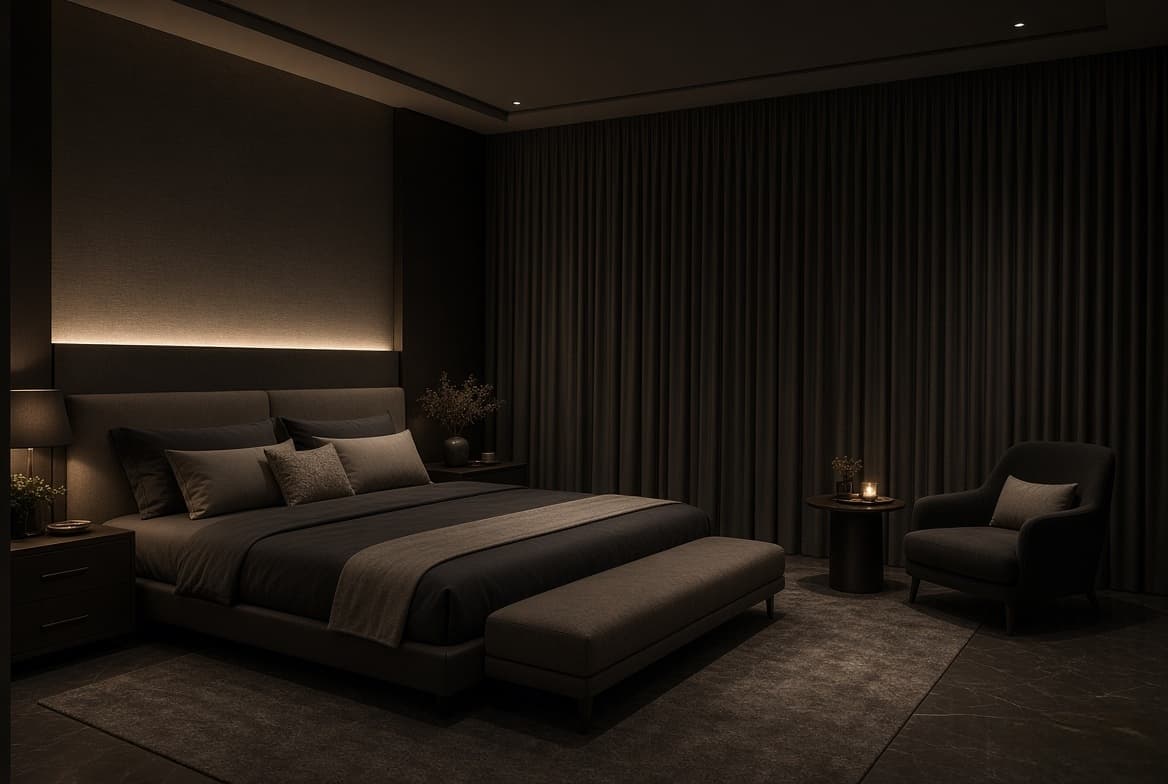
The Recommended Blackout System for Master Bedrooms
Best performing combination:
- Ceiling-mounted track (or very high wall mount)
- Full blackout curtains with side returns
- Optional sheer layer for daytime privacy and soft light
For clients who want the absolute highest level of darkness, we often add a blackout roller blind closest to the glass in addition to the curtains. This double system is the closest most homes can get to a hotel-style blackout.
Exact Measurement Protocol for Blackout Performance
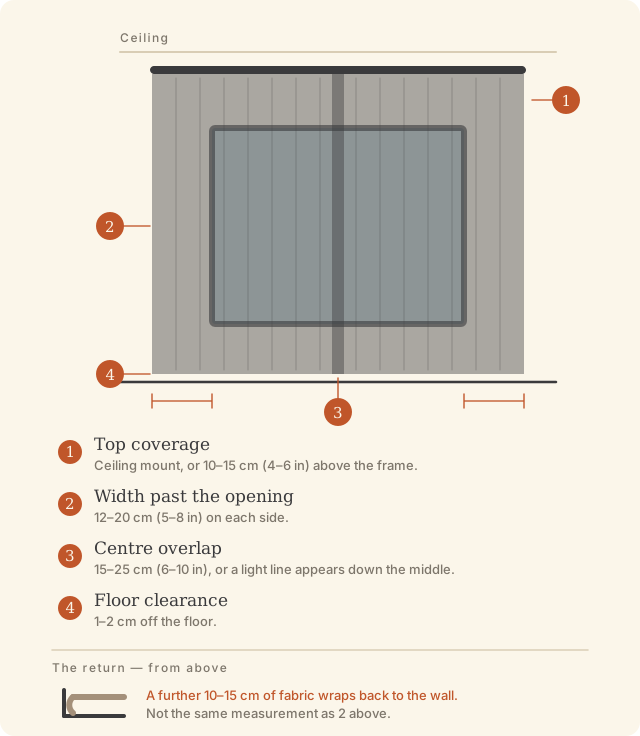
Step 1: Mounting Height
Prefer ceiling mount whenever the structure allows. This eliminates the top light gap that ruins most installations. If ceiling mounting is not possible, mount the track as high as possible above the window and use a pelmet or a fabric return at the top.
Step 2: Width — The Most Critical Measurement
Measure the window opening including frame. Add a generous 25–40 cm (10–16 in) of total extra width — 12–20 cm, or 5–8 in, on each side. West- or east-facing master bedrooms need the higher end of this range. The extra width allows the curtains to return to the wall and stop light from leaking around the edges.
Step 3: Finished Length
Kissing the floor, or a maximum of 1–2 cm (under an inch) clearance, is ideal. In bedrooms, a very slight break of 2–3 cm, about an inch, can also work and feels more luxurious. Avoid long puddles — they collect dust and can be a nuisance when walking around the bed in the dark.
Step 4: Returns and Overlap
Specify side returns (fabric that wraps back to the wall) of at least 10–15 cm (4–6 in) on both ends. Centre overlap when closed should be 15–25 cm (6–10 in) so no vertical light line appears in the middle.
Fabric and Lining Specifications
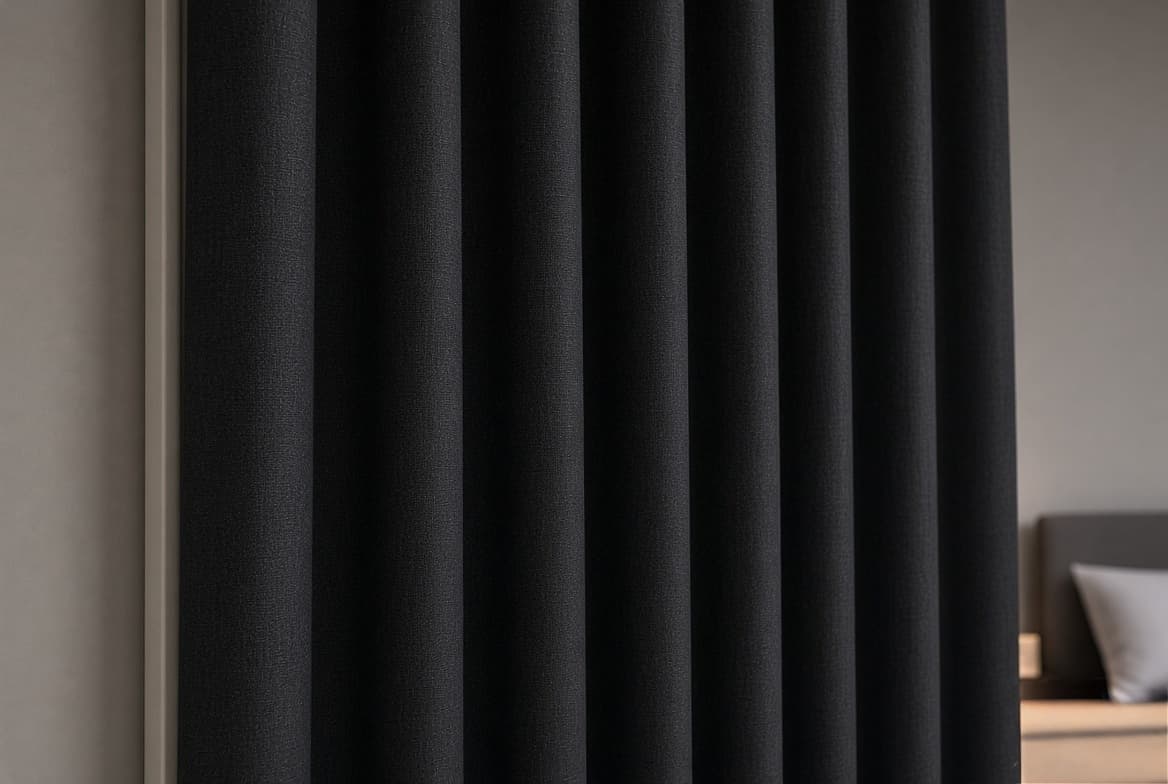
Face fabric can be chosen for style, but the blackout performance comes from the lining or the base cloth. Triple-weave blackout or high-quality foam-backed blackout lining is preferred.
For deep sleepers, a thermal interlining between the face fabric and blackout lining adds both better light block and improved temperature stability. Darker face fabrics generally perform better than very light ones, but a good blackout lining can make even lighter colours work.
Additional Details That Make the Difference
- Pelmet or top return: Even a simple fabric-covered pelmet or a track with a built-in cover stops the line of light that often appears at the top.
- Side channels or magnetic returns: In extreme cases (street lights directly outside, very light-sensitive clients) we can add side channels or magnetic strips.
- Door treatment: If the master bedroom has a door with a glass panel or an attached balcony door, that opening must be treated with the same seriousness as the windows.
Motorisation Considerations
Master bedrooms benefit strongly from motorisation:
- Easy to close the curtains while already in bed
- Consistent daily use (people are more likely to close blackout curtains properly if it is effortless)
- Quiet motors are important — choose systems rated for bedroom use
Always plan for manual override in case of power cuts.
Common Failures and How to Avoid Them
- Track mounted only on the window frame → large top and side light gaps
- Insufficient extra width → light leaks around the edges
- No centre overlap → vertical line of light down the middle
- Cheap “blackout” coating that still pinholes when a torch is held behind it
- Ignoring the balcony door or bathroom window connected to the bedroom
Client Variations
Very light-sensitive sleepers / shift workers
Double system (roller blind + full blackout curtains) + side returns + pelmet.
Couples with different preferences
Motorised system with good intermediate stop positions so one person can have more light without fully opening the curtains.
Bedrooms with large west-facing windows
Treat heat and light together — thermal interlining becomes especially valuable.
Attached dressing area or bathroom with windows
These secondary openings are often forgotten and become the source of residual light.
Final Recommendation
A true blackout master bedroom is less about buying the darkest fabric and more about precise coverage. When the track is high enough, the width is generous enough, the returns are properly made, and the centre overlaps correctly, even a good mid-range blackout curtain can deliver excellent results.
The clients who sleep best are the ones whose installation was measured and detailed specifically for blackout performance rather than just “looking nice”.
For exact specifications tailored to your bedroom dimensions, window orientation, and sensitivity to light, a professional measurement visit is the most reliable starting point.
Still stuck? Send a photograph of the window on WhatsApp and we’ll tell you what will and won’t work. Or read more about curtains.
This is the point where a measurement usually matters more than a preference. If you’d like us to look at it properly, start here.
Send a photo of the window — it usually tells us more than a description.
Read next
- East-facing living room light control
Sheer and dimout combinations with exact measurements, for an east-facing living room that has to take the Hyderabad morning without going dark.
- Master bedroom with an attached balcony
How to treat a sliding balcony door and its windows as one job — blackout, privacy, heat and daily use, on the tracks a master bedroom here needs.
- Toddler & infant room light control
Gradual darkening, safe cord-free systems and the measurements behind them, for infant and toddler rooms where the naps happen in daylight.
- A kids’ bedroom in Hyderabad — safety first, then sleep
Cord-free window hardware, blackout that survives a daytime nap, a sleep surface that can be washed, furniture that stays up, and one wall that gets to play.
- Bedroom curtains in Hyderabad
Blackout for the tower opposite rather than the sunrise, a lining that helps the AC, and a drop that meets the floor. How we hang a bedroom curtain here.
- Headboards — the designs, the build, and the one you already own
What a headboard is actually doing, how an upholstered one is made, the six shapes Indian homes keep asking for, and whether yours is worth recovering.
NBT Nagar, Banjara Hills, Hyderabad 500034+91 96769 21216