
Curtain fabrics in Hyderabad
Aakriti Nagpal · 10 September 2026 · 25 min read
What the cloth is made of, when blackout earns its cost, how 3.0 fullness is calculated, and which heading belongs on which Hyderabad window.
A curtain is three decisions wearing one piece of cloth. The fibre decides how it lives in this climate. The lining decides what the room does at two in the afternoon and at eleven at night. The heading and the fullness decide whether it looks like a curtain or like a sheet hung on a rail.
Colour comes after those three, which is not how most people shop.
Hyderabad adds its own list. Ten- and eleven-foot ceilings. West glass that holds heat until evening. Towers thirty feet apart. Dust that never quite leaves. A monsoon that makes linen grow. Builder openings that are an inch off the drawing.
This is the working note we use when somebody stands in the showroom and asks what they should put on the window.
The fibres, and what each one is for
Eight faces you will actually be asked to choose between. The lining is a separate cloth, and it comes later on this page because it is a separate decision.
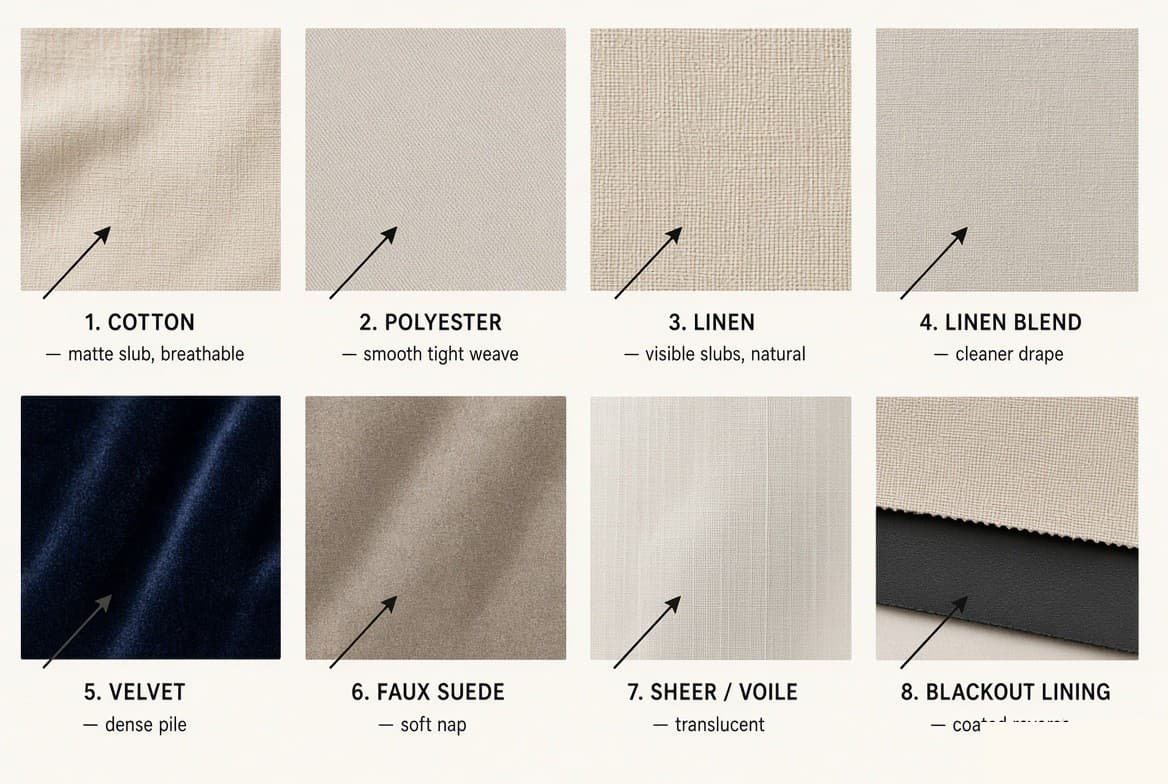
Cotton
Matte, breathable, familiar. A good cotton drapes softly and takes dye well. It also creases, it can shrink if it is washed hot, and strong afternoon sun will fade it faster than a polyester. Use it in rooms that do not take the west sun full in the face, or put a lining behind it so the ultraviolet hits the lining first. Fine cotton voile is a sheer, not a main curtain.
Where. Living rooms that want a soft, unshiny face. Guest rooms. East and north windows.
Care. Vacuum. Gentle machine wash if unlined and the label allows it. Lined panels are usually dry-clean. Steam — do not iron a hard crease into a drape.
Polyester
The workhorse of this city and of every hotel we have furnished. It holds colour in the sun, it does not grow in the monsoon, and it comes in every weave from a cheap shine to a linen-look that fools the hand at a metre. The better polyester is a tight, dull weave. The worse one is shiny and thin and reads as plastic the moment the sun hits it.
Where. West windows, road-facing rooms, households that open and close the curtain twice a day, anywhere a natural fibre would fade or sag.
Care. Vacuum. Most performance polyesters wipe and some take a gentle wash. Lined blackout panels follow the lining’s care, not the face’s.
Linen
The slub and the slightly imperfect hang that people mean when they say linen. It wrinkles, and the wrinkles are part of the look. It also takes moisture from the air — a panel hemmed in a dry April can sit a little longer in August. On a floor-length curtain that is the difference between clearing the floor and brushing it. Unlined linen on a west window will fade unevenly: the leading edge and the folds that sit forward go first.
Where. North and east living rooms, garden-facing glass, rooms where the texture is the point. Not, unlined, in a bedroom you intend to sleep in.
Care. Vacuum with an upholstery head. Steam rather than press. Lined panels are often dry-clean because of the lining. Do not judge the drop in the first wet week of the monsoon.
There is a longer piece on linen in this climate if it is the one you keep coming back to.
Linen blends
Linen with cotton, viscose, or a small polyester content. Holds a cleaner line than pure linen and often sits better on a wave track. For a busy household, or a window opened twice a day, the blend is the more honest choice: you keep most of the hand and lose some of the wrinkle and the monsoon drop.
Feel both. Weight matters more than the label.
Where. Most Hyderabad living rooms and bedrooms that want a linen look without a linen temperament.
Velvet
Pile, weight, and a hotel-suite quiet. It takes the edge off sound in a tiled room and it cuts light even before you add a lining. It also marks if you drag a hand across it, it holds dust in the pile, and it has no place in a small room that runs on a fan through April and May. A large, air-conditioned bedroom or a formal living room can carry it. A 10×12 flat with one AC cannot.
Where. Large AC bedrooms, dining rooms, media rooms. Not kitchens, not wet balconies, not fan-only rooms.
Care. Vacuum the pile with an upholstery head, always in the direction of the nap. Steam from the reverse. Do not crush it wet. Many velvets are dry-clean only.
Faux suede
Not leather. A polyester — sometimes microfibre — with a short brushed nap that reads as suede from the door. Soft, dense, good body, a natural dimout even before lining. It hides a small stain better than a flat satin. It shows every fingertip if the colour is pale. And it does not like water on the face: a wet wipe leaves a tide mark on the nap.
Where. Bedrooms and living rooms that want a matte, tailored face without velvet weight. Good on a pinch pleat. Less good on a cheap eyelet rod that will wear the heading.
Care. Vacuum the nap. Spot-clean with a barely damp cloth and let it dry flat. Do not machine-wash a suede-look panel and expect the nap to survive.
Sheers and voiles
Daylight stays. The view in is blurred. Weak at night once the lamps are on — anyone outside can see in. That is why a sheer is a layer, not a finished window, on a ground floor or in a tower that faces another tower. Polyester voile is the daily sheer. Linen and linen-look sheers are the ones that justify themselves in a living room.
Care. Gentle wash if the label allows. Hang it wet so the drop settles. A sheer that has been ironed flat has lost the point.
Silk, satin and the shiny faces
They photograph. They also show every water spot, every crease and every hour of west sun. We use a silk-look polyester when a dining room wants a formal face and the glass does not bake. Real silk on a Hyderabad window is a conservation project, not a curtain.
A rule that saves arguments later
We work only with fabric we have supplied. Colour, rub, how the cloth takes a staple or a pinch, and how it hangs after a monsoon are not things anyone can judge off a roll that arrived from somewhere else. If you have a cloth you love, bring a cutting and we will tell you honestly whether it will make a curtain. That, and the rest of what we will and will not take on, is written down on the FAQ.
What quality cloth costs
These are 2026 bands for cloth by the metre at the quality end of the market — before lining, stitching, hardware, installation and GST. A finished Hyderabad window is quoted by the panel, not by the metre, so treat these as what the face fabric contributes rather than as the price of a curtain.
| Cloth | Quality band, per metre |
|---|---|
| Sheers and voiles | ₹700–2,000 |
| Cotton | ₹800–1,600 |
| Branded or performance polyester | ₹900–1,800 |
| Linen blend | ₹1,200–2,500 |
| Faux suede | ₹1,200–2,800 |
| Velvet | ₹1,500–3,500 |
| Designer jacquard | ₹1,500–3,500 |
| Pure linen worth hanging | ₹1,800–4,500 |
Printed and embroidered cottons sit above their band, as do imported designer linens and silk-mix velvet pile.
The lining is a separate cloth and a separate cost, and it is the cheap half of the decision.
| Lining | Quality band, per metre |
|---|---|
| Cotton lining — body and some UV | ₹350–700 |
| Dimout lining | ₹400–800 |
| Two- or three-pass blackout lining | ₹400–900 |
The three-pass is the one that actually goes dark. A lining takes the ultraviolet, costs a fraction of the face, and is the part you replace in five years instead of the whole curtain.
Always confirm against the current book — cloth moves, and a quote at half these numbers is usually quoting 2.0 fullness, no lining, or both.
Sheer, dimout, blackout — when each is the right answer
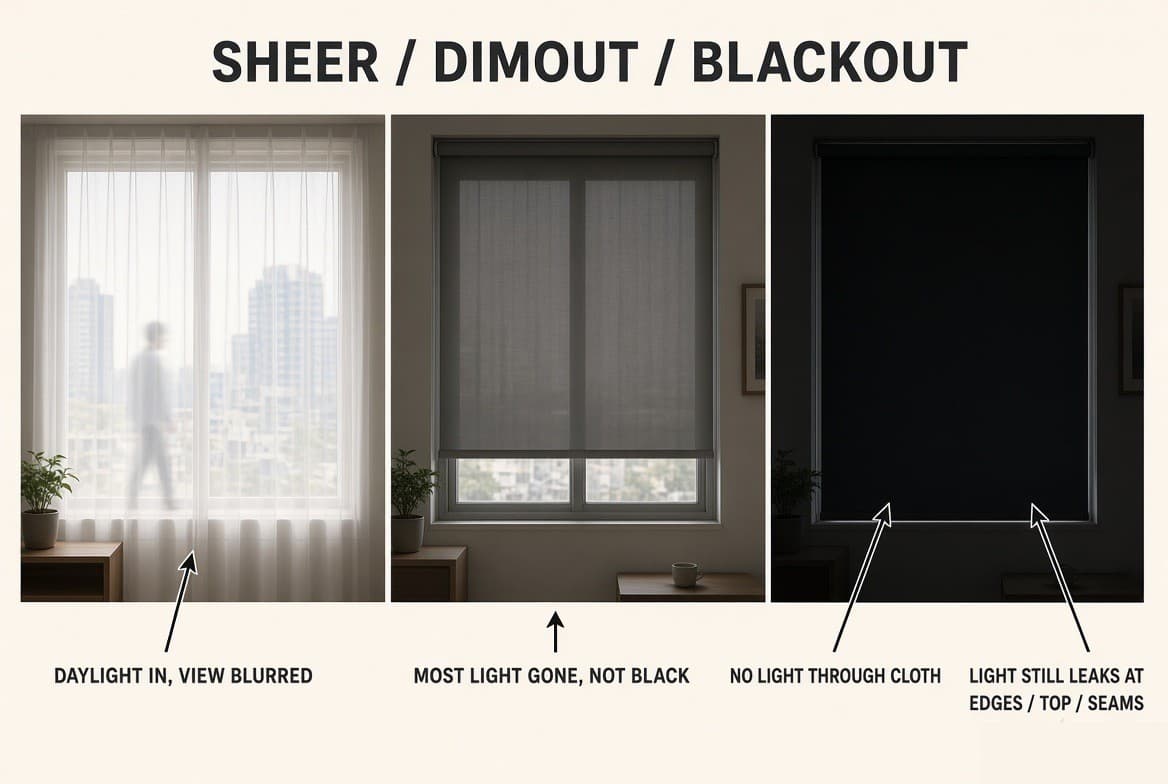
True blackout is a lining, not a marketing word on a packet. The face cloth can still be linen, cotton, a velvet. The lining is what makes the room go dark.
A blackout lining stops light through the fabric completely. What gets past it is the gap at the sides, the gap at the top, and any seam. That is why we prefer wide-width cloth on a tall window, a return to the wall, and an overlap at the centre.
- Full blackout — nurseries, shift workers, west-facing bedrooms, any room that faces a tower or a streetlight. Most master bedrooms in this city.
- Dimout — when you would rather the room woke with the day. Studies. Living rooms that need calm without going black.
- A sheer — garden-facing living rooms by day. Always as the inner layer on a double track if you also want darkness at night.
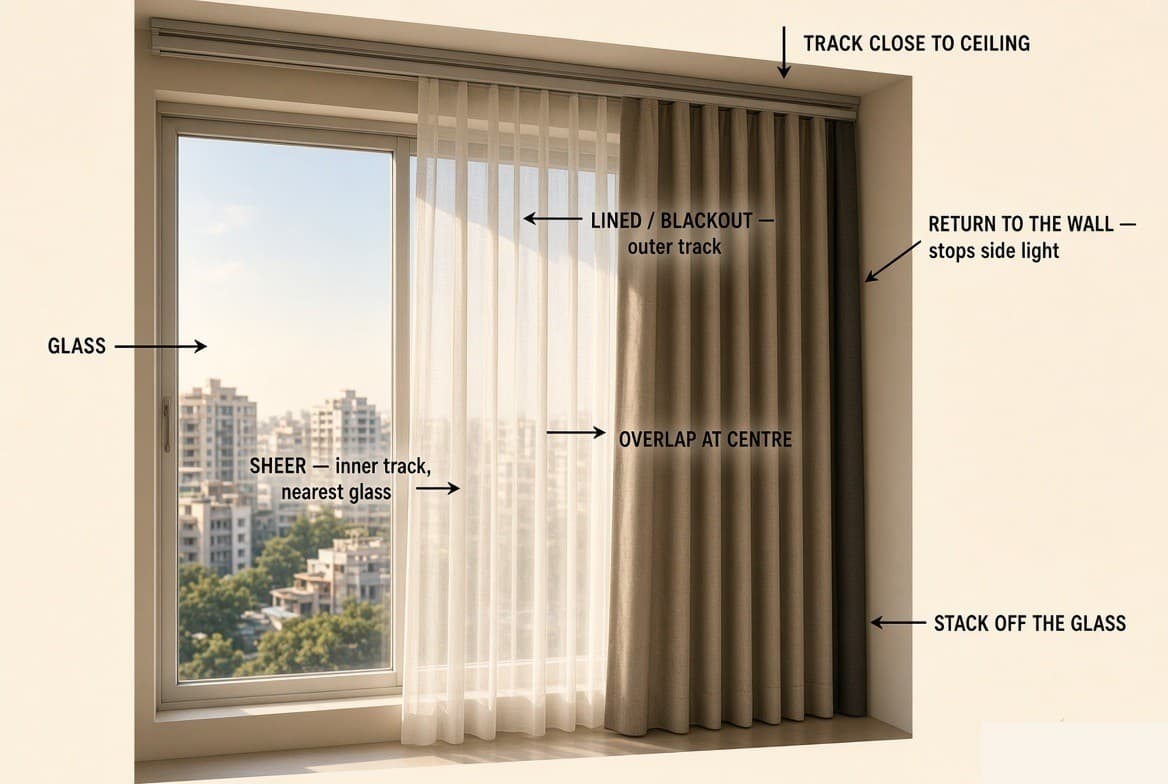
The arrangement most master bedrooms here end up with is two tracks: a sheer nearest the glass, a blackout-lined pair in front. By day the sheer hangs alone. At night the heavy pair is drawn. One window, two behaviours.
A single blackout curtain means the room is either fully shut or fully open, which is why people stop using them. The whole blackout system is worked through here.
A lining takes the ultraviolet, costs a fraction of the face fabric, and is the part you replace in five years instead of the whole curtain. Unlined linen on a west window is how you buy the face twice.
GSM — what it is, and what it does not tell you
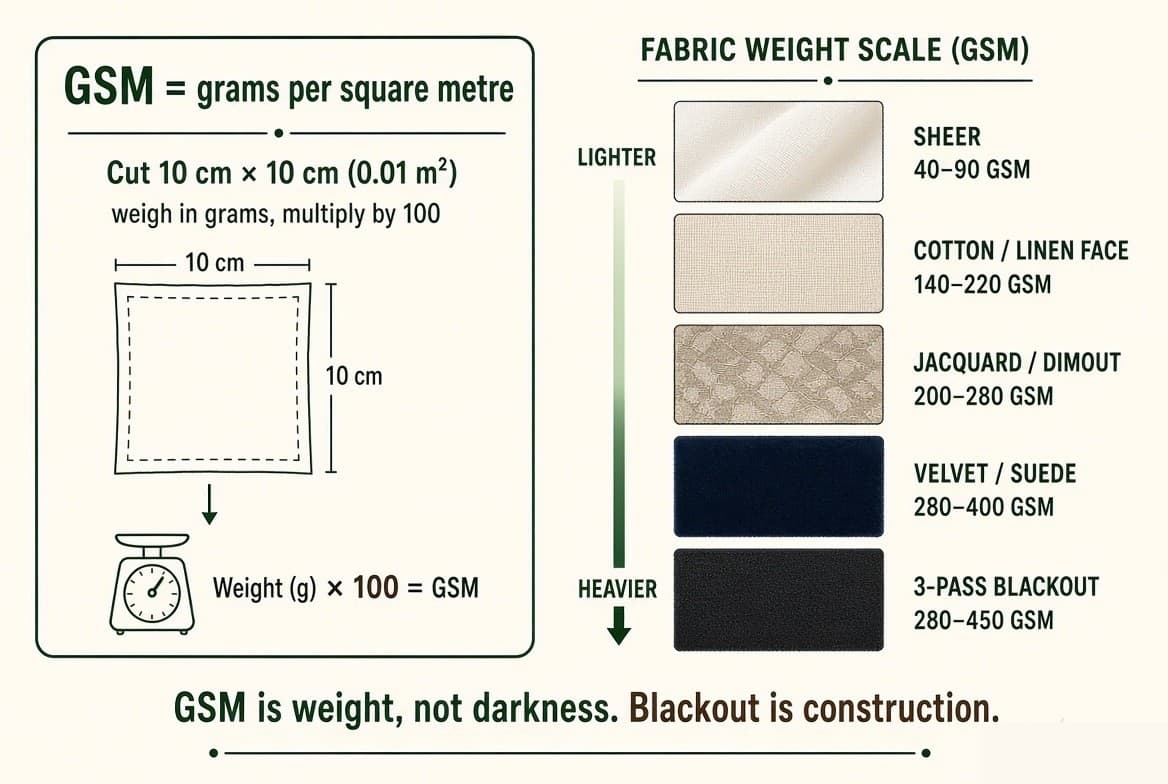
GSM is grams per square metre. It is weight.
A workshop uses a 100 cm² cutter for it — a round one in a proper lab, a 10 cm square if you are doing it by hand. Either way, weigh the piece in grams and multiply by 100. A 1.80 g sample is 180 GSM. Without a cutter, weigh any rectangle and divide by its area in square metres.
These are the bands we actually hang.
| Cloth | Typical GSM | What that feels like | Roughly, 1 m of 140 cm cloth |
|---|---|---|---|
| Sheer / voile | 40–90 | Air, hangs like smoke | 60–130 g |
| Cotton / linen face | 140–220 | Soft body, folds hold | 200–310 g |
| Linen blend / jacquard | 180–280 | Structured drape | 250–390 g |
| Dimout face | 200–280 | Calm, not stiff | 280–390 g |
| Velvet / faux suede | 280–400 | Heavy, quiet | 390–560 g |
| Three-pass blackout lining | 280–450 | The dark layer | 390–630 g |
A lined pinch-pleat pair on a three-metre Hyderabad slider, at 3.0 fullness, with blackout behind it, is easily 12 to 20 kilograms hanging on the track. That is why a hollow-wall plug is not a track fixing, and why a long heavy run wants a corded or motorised track split at the centre. The hardware side of that is its own article.
GSM is not blackout. A 300 GSM jacquard can still glow at noon. A 180 GSM cloth with a three-pass lining can go dark. Ask what the lining is, not only what the face weighs.
3.0 fullness, and the arithmetic behind it
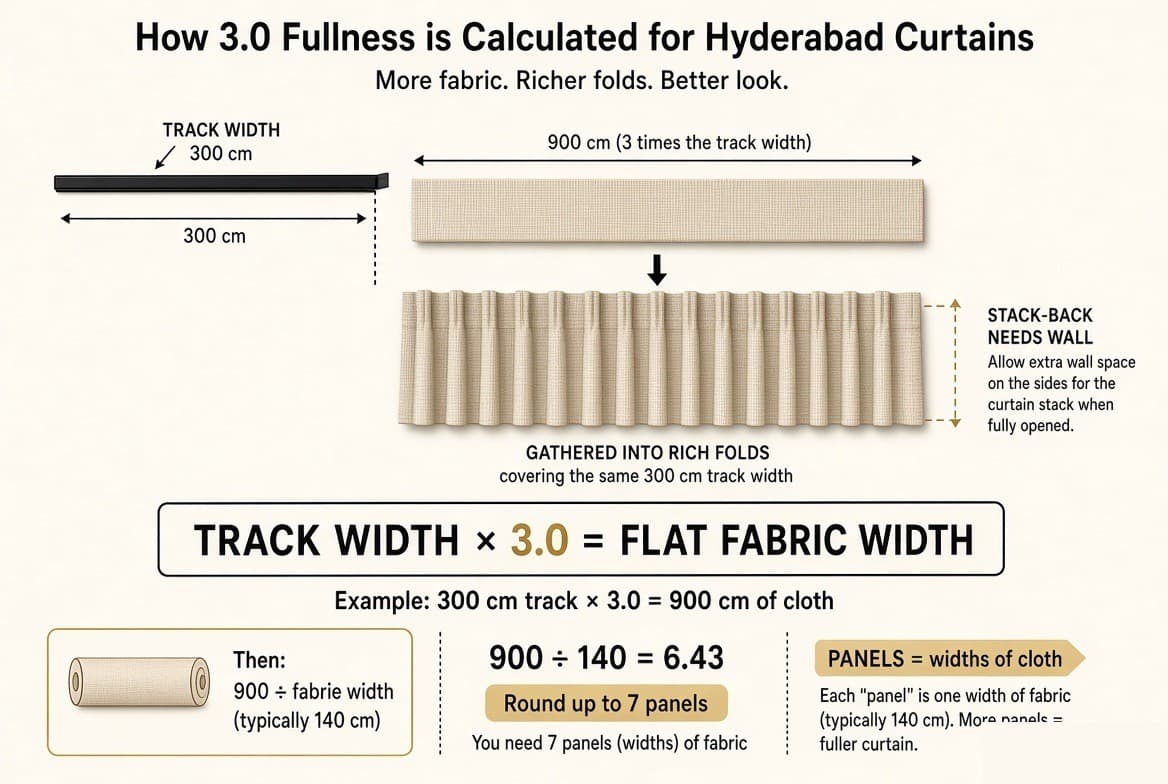
Fullness is how much flat cloth is gathered onto the track. A curtain cut to the exact width of the window looks skimpy when it is closed and never quite meets in the middle. Gaps at the edges are where the afternoon light and the dust come in.
We cut for 3.0 fullness. That is three metres of flat cloth for every metre of track. It is the fullness that makes a pinch pleat look like a pinch pleat and a wave look like a wave, rather than a sheet.
Quotes that come in at half the price are almost always quoting 2.0 or less, and often omitting the lining. Ask both quotes how many panels per window and what lining sits behind them. Two quotes that differ by half are usually not quoting the same curtain.
The calculation, written out.
- Measure the track, not the glass. If the track does not exist yet, measure the finished opening plus the stack-back you want on each side.
- Flat fabric width = track width × 3.0. A 300 cm track wants 900 cm of flat cloth.
- Number of panels = 900 ÷ the cloth’s width. Most furnishing cloth is 140 cm, though some sheers and blackouts come 280 to 300 cm wide. 900 ÷ 140 = 6.43, which is seven panels.
- Drop = finished drop + heading allowance + hem. On a ten- or eleven-foot Hyderabad ceiling that is a lot of metres. Patterned cloth adds one extra repeat per drop so the pattern matches across the joins.
A pair is the usual answer: the panels split left and right of the centre. A single panel on a wide slider looks generous in a photograph and is miserable to draw with one hand at half past six in the morning. Two panels, overlapping at the centre. On a very wide run, four, meeting in two places — or a motor.
One pair of the face cloth per window. If you are layering, the sheer is a second pair on its own track. Two pairs, one window; not two pairs of the same cloth. A spare set is only worth making if the cloth will take a beating — a holiday house, a rental — and you want to rotate. For a private flat, one well-made pair plus a sheer is the working set.
Headings and pleats
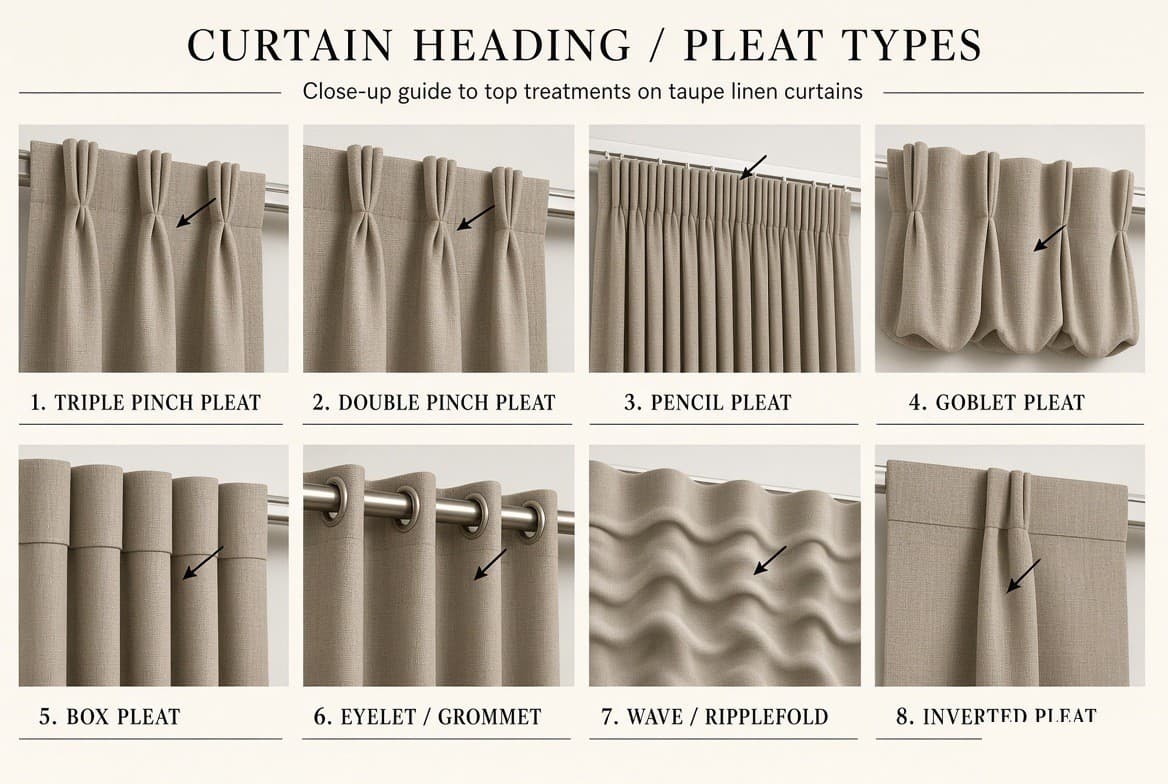
The heading is the part that has to work at 6.30 in the morning. Choose it for the hand, then for the look.
- Triple pinch pleat. Three folds pinched and sewn. The formal fold. Needs 3.0 fullness and enough wall to stack into. Living rooms, dining rooms, tall windows.
- Double pinch pleat. The same idea with two folds. Slightly less cloth in each pleat, slightly slimmer stack. Still a tailored heading.
- Pencil pleat. A tape with three rows of pockets. The row you put the hook in sets how high the curtain sits relative to the track. Forgiving to adjust later. Less tailored than a sewn pinch.
- Goblet pleat. A pinch whose head is stuffed so it reads as a cup. Formal, and a dust trap. Dining rooms that are used in the evening.
- Box or inverted pleat. A flat, inverted box. Architectural. Wants a cloth with body.
- Eyelet or grommet. The rod goes through the rings. Simple, cheap hardware, opened every day without thinking. The least forgiving if the drop is wrong — you cannot ride the hook row up or down. Bedrooms.
- Wave or ripplefold. Carriers on a concealed track hold the cloth in a repeating S. Open, the waves compress; drawn, they keep the same shape. The clean answer on a long run of glass and a false-ceiling pocket.
Rod-pocket and tab-top drag when you open them every day, and a bedroom curtain is opened more than any other in the house. We do not specify them for daily windows.
How the curtain is stitched
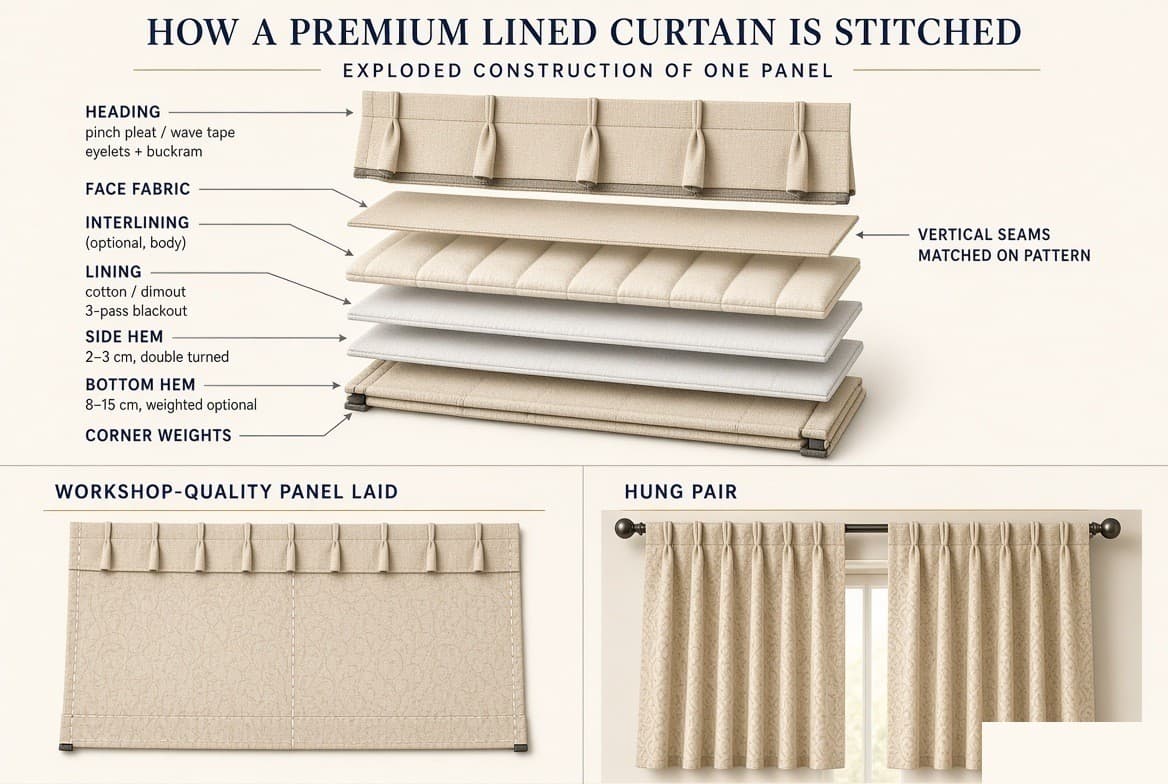
- Seams. Widths of cloth joined selvedge to selvedge. On a pattern the repeat is matched so the join disappears from the door. On a plain cloth the join is still pressed open and hidden in a fold.
- Side hems. Double-turned, 2 to 3 cm, so the raw edge never sees the sun.
- Bottom hem. Deep — 8 to 15 cm — so the panel hangs with weight, and so a small monsoon drop can be taken up later without remaking the heading.
- Heading. Buckram or a firm tape in a pinch pleat. Wave tape matched to the carrier pitch. Eyelets punched with a washer so they do not tear.
- Lining. Lock-stitched to the face at the heading and at points down the drop, so the two cloths move as one. A lining that balloons is a lining that was only tacked at the top.
- Weights. In the corners, and along the hem on sheers and long lined drops, so the leading edge falls straight instead of kicking.
Interlining — a third, soft layer between face and lining — is the difference between a curtain that looks expensive and one that is. It is worth it on a velvet, a linen, and any formal living-room pair. It is how hotels get the silent, heavy draw. It is also how a 3.0-fullness pair gets heavy enough to need a proper track.
Plain, abstract, jacquard, print
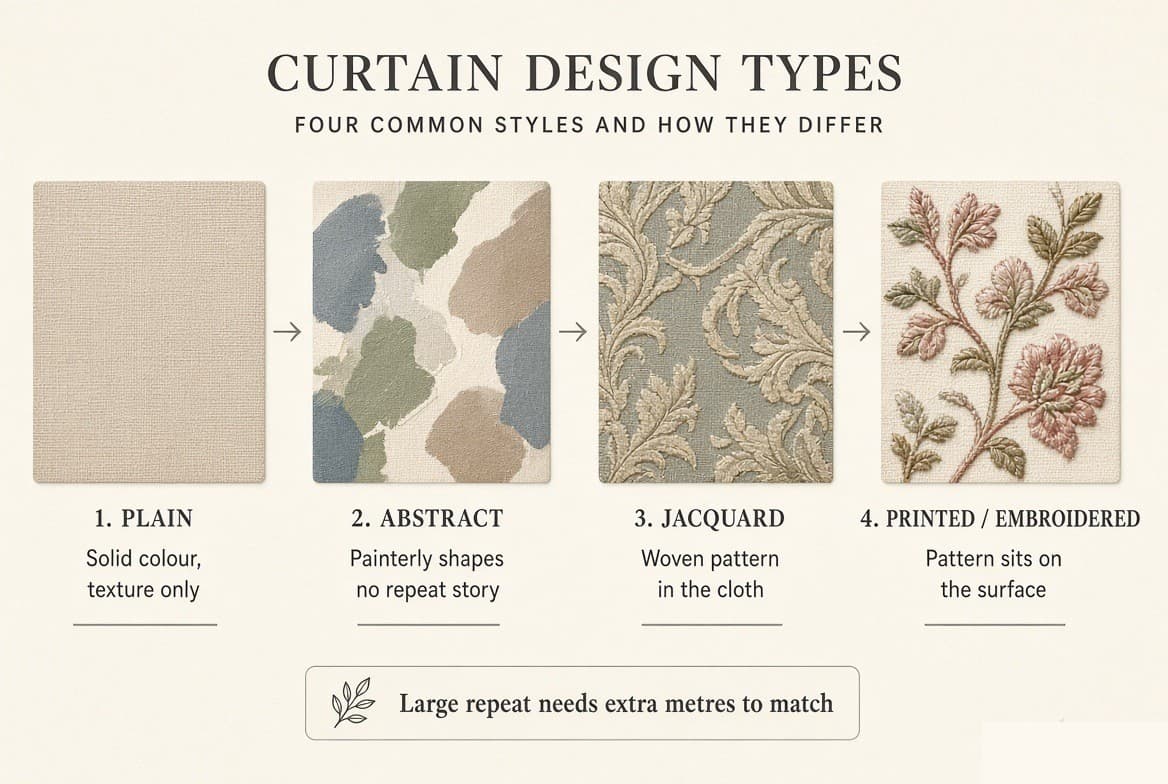
- Plain. One colour; the interest is the weave. The honest default in this climate. Hides dust in flax, oatmeal, stone, clay, dusty olive. Shows it in white.
- Abstract. Large painterly shapes, often with no tight repeat. Works on a wide slider. Can look busy on a small window.
- Jacquard. The pattern is woven rather than printed, so it is in the cloth and not on it. Durable. Nothing sitting on the surface waiting to rub off.
- Printed. The pattern is applied. Fine if the cloth was made for windows. A dress print on a west window is how you watch a design disappear in two summers.
- Embroidered. Thread on the surface. Beautiful, and it catches dust. Keep it for a dining room or a formal pair that is drawn at night, not for a road-facing sheer.
A large repeat needs extra metres so the pattern matches across the joins and across the pair. That extra is not padding the bill. It is the difference between a curtain and a mismatch you will see every evening.
Which cloth in which room
| Room | Face | Lining or layer | Heading that behaves |
|---|---|---|---|
| Master bedroom | Linen blend, performance polyester, suede, velvet if the room is cooled | Blackout, plus a sheer on a second track | Wave, pinch or eyelet |
| Child’s room | Performance polyester, washable blend | Blackout; cord-free track or a motor | Wave or eyelet |
| Living, garden-facing | Linen or linen blend, and a good sheer | Unlined or cotton-lined; the sheer alone by day | Pinch or wave |
| Living, west or road | Tighter weave; velvet only if the room is large and cooled | Dimout or blackout, plus a sheer | Wave on a long slider |
| Dining | Jacquard, velvet, linen blend | Cotton or dimout | Pinch or goblet |
| Study or WFH | Dimout face, or a lined blend | Dimout — you need the screen readable | Wave or eyelet |
| Kitchen or utility | Not a curtain, if there is oil or steam | A blind inside the reveal | — |
| Wet balcony door | Not untreated cloth on the glass | Roller or Roman in the reveal; dress curtains only if there is wall to stack into | — |
What hotels and resorts actually hang
At Lore, and on the other hospitality jobs, the brief is the same every time: it has to look like a room a guest would book again, and it has to survive a housekeeper. That rules out untreated linen on the glass and anything that cannot be washed.
- Inherently flame-retardant polyester — Trevira CS and its cousins — because a topical FR dip washes out after a few dozen laundry cycles and then the certificate is a piece of paper.
- Guest rooms: sheer and full blackout on two tracks, a performance face, usually a wave or a pinch. Wide-width blackout so there is no horizontal seam glowing at half past five in the morning.
- Lobbies and restaurants: heavier jacquard or velvet where the look has to carry, still flame-retardant.
- Contract cloth is specified to a wash test, a light-fastness rating and a fire standard — BS 5867, NFPA 701, or whichever the consultant names. Domestic linen is not.
A house does not need a hotel certificate. It does need the same honesty about wash and sun. If you want a holiday-house pair that a cook will wash, say so before we cut a dry-clean linen.
The distance from the floor to the hem
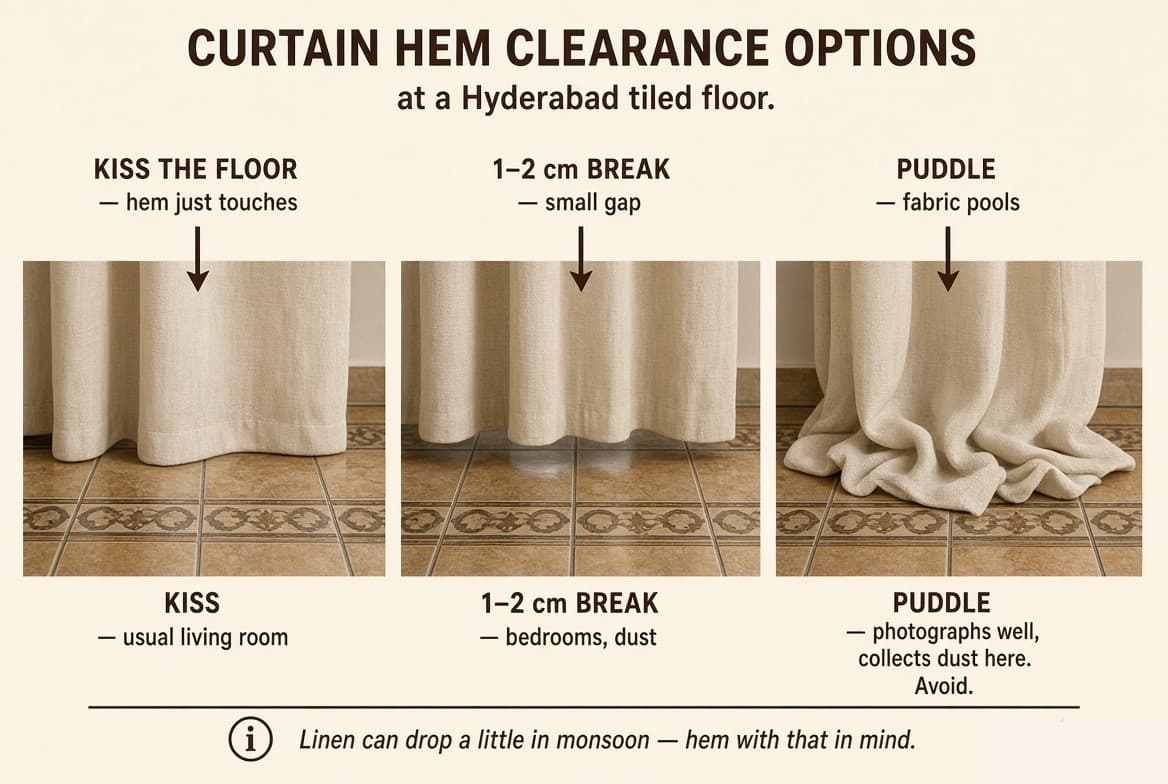
The drop is measured from the track or the rod to where the hem should sit. Not from the ceiling, and not from the top of the window frame.
- Kiss. The hem just meets the floor. The usual living-room answer when the cloth is stable.
- A 1–2 cm break. Clearance. The bedroom answer, the linen answer, and the answer anywhere the floor is swept daily. Also the answer if the floor is not yet finished when we measure — we confirm after the last coat.
- Puddle. Looks generous in a photograph. Collects dust in this city. Catches a bare foot at night. We do not specify it on a working window.
Linen takes up moisture, and a panel can sit longer in August than it did in April. Hem linen with a small break rather than a kiss, and do not judge the drop in the first wet week.
When curtains, when blinds
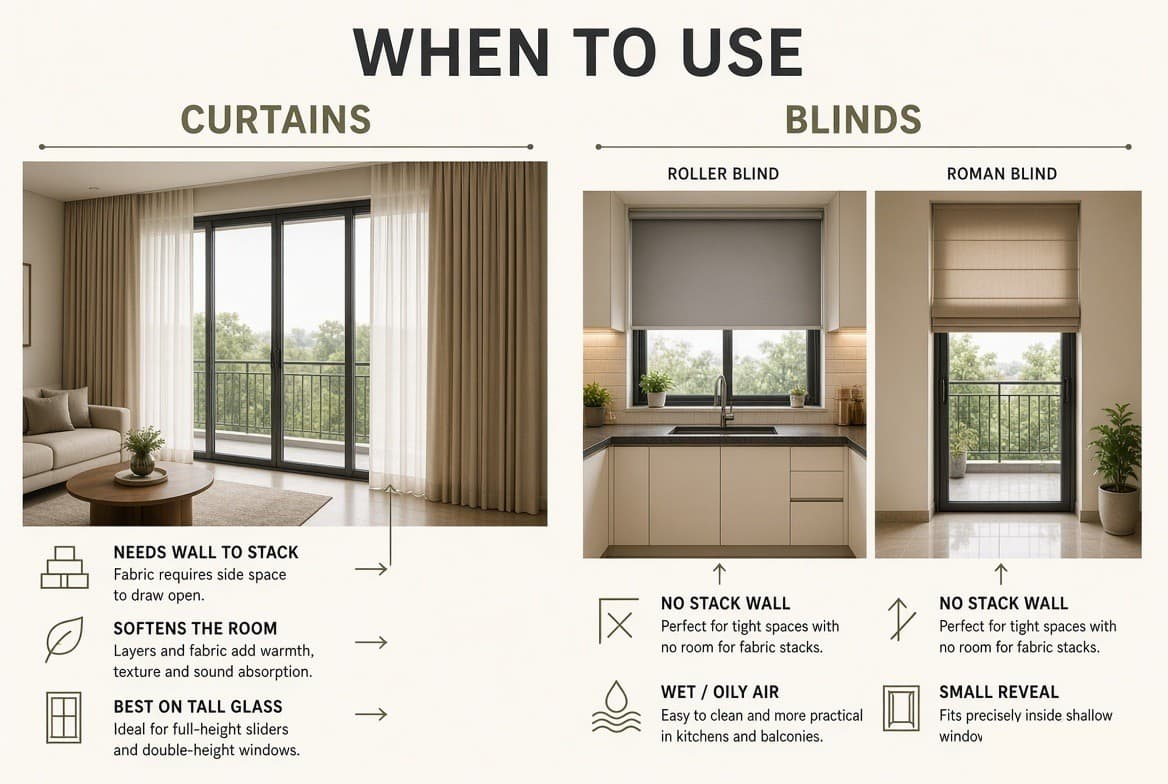
Curtains want wall to stack into. Blinds live inside the reveal and take up nothing.
Blinds earn their place where there is no room for fabric to stack, where the window gets wet, or where you want light without being seen — small windows that curtains would swallow, kitchens with oil in the air, wet balconies, tight reveals, a glass corner with no stack wall, a study that needs glare control without a column of cloth. Which blind for which window is its own article.
The hybrid that solves most awkward bedrooms: a Roman or a blackout roller inside the reveal, and curtains that stack off the glass. The blind does the dark. The curtain does the room.
Limitations — say these before anyone cuts
- A gypsum partition will not hold a curtain track at all — not a heavy pair and not a light one. Board is a lining, not a structure, and a bracket levers the weight straight out of it. Fix to masonry, to the slab, or to a noggin put in before the boarding. The whole of that is here.
- A window with no wall either side cannot take a stacked curtain. That is a blind, or a ceiling track that runs past onto the next wall.
- Blackout cloth does not make a dark room if the track has no return, the pair has no overlap, and there is a seam across an eleven-foot drop.
- Motors want a power point at the track. Decide that with the electrician, not after the false ceiling is closed.
- Patterned cloth on a 3.0-fullness tall drop uses more metres than a plain. The repeat is not optional.
- We will not hang a customer’s own cloth, and we will not hang a cheap shiny polyester and call it linen.
- Mesh and grills between the glass and the cloth change the standoff. Measure with them in place.
When to order
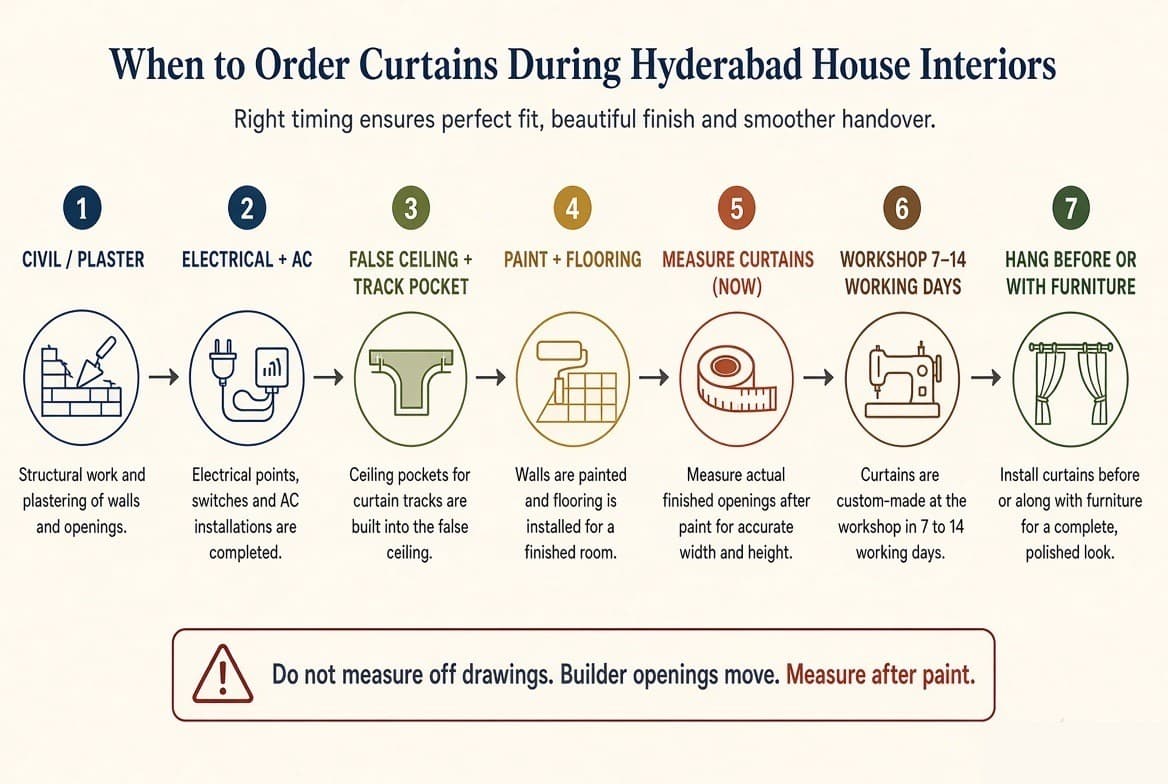
The civil work does not care about curtains. The false ceiling does. If you want a concealed track, the pocket is decided with the carpenter and the electrician, not after the gypsum is painted.
- Civil, plaster, electrical, AC. Tracks need power if they will be motorised, and AC indoor units on the window wall have to miss the heading.
- False ceiling, and any pelmet or track pocket.
- Paint and flooring.
- Then we measure. Builder openings move. An inch off the drawing is a remake.
- Workshop — typically 7 to 14 working days once the cloth is approved and the measurements are signed. Longer if the cloth is indented, or if it is a large villa; hospitality runs to a programme.
- Hanging. A single window is an hour once the track is up. The track is the part that takes the time, if the wall is a surprise.
That range is the ordinary case, not a promise about your window — the date on your quote is the one to hold us to, and the FAQ says so too. Measuring, making and fitting are all ours, so there is no third party to blame for a delay.
Order so the finished pair arrives after the paint is stable, and before you start living with a bed pushed against an unfinished window. On a turnkey job we hang as the rooms come off the painter, not all on the last Saturday.
Buying — do, and don’t
Do.
- Feel the cloth in the room’s own light, not only in the showroom. West light changes colour.
- Ask for the panel count, the fullness, the lining and the heading, in writing.
- Ask what the blackout actually is — a three-pass lining, or a darker dye.
- Take a cutting home and hold it against the wall for a day.
Don’t.
- Buy a cheap quote that will not say how many panels it has allowed.
- Choose unlined white linen for a road-facing west window and expect it to look the same in two summers.
- Decide the heading from a photograph of a villa when you have a 10×11 bedroom with no stack wall.
- Confuse GSM with blackout.
Installing — do, and don’t
Do.
- Fix into masonry or the slab. Ceiling-mounting a tall window makes the wall read taller.
- Set the track high, and run it past the frame so the stack sits on the wall rather than on the glass.
- Use the same hook row on both panels of a pair. On a wall-fixed track the bottom row of pencil-pleat tape hides the track; on a pole the top row lets the pole show.
- Use metal hooks on a long, lined, sunny drop. Plastic goes brittle.
Don’t.
- Drill a track into a hollow partition and hope. A cavity anchor is not a rescue; it spreads the load over more of the same board.
- Hang before the floor is finished and then argue about a 15 mm discrepancy.
- Leave a bright vertical gap where a balcony slider meets a window. Treat them as one run.
- Start a motorised track after the false ceiling is closed and discover there is no power at the head.
What to send us
A photograph of the window from the room, and one from closer so we can see the reveal, the grill, the AC and the wall either side. The ceiling height if you know it. Whether you want the room dark at night. Whether the track should vanish into a false-ceiling pocket or sit on a pole.
That is enough to say whether this is a curtain, a blind or both, and whether the cloth should be a linen blend or a tighter weave.
Fabric still needs a hand on it. Colour and weight both photograph badly.
Come and see the cloth. We measure the window rather than the drawing, we make the curtains ourselves, and the people who quote the job are the people who see it hung. The showroom is House No 536, First Floor, Road No. 12, NBT Nagar, Banjara Hills, Monday to Saturday, 11am to 8.30pm. A site visit is ₹500 and it comes off the bill if you go ahead.
Curtains are here if you want the short version, and the hardware above them is here.
Still stuck? Send a photograph of the window on WhatsApp and we’ll tell you what will and won’t work. Or read more about curtains.
This is the point where a measurement usually matters more than a preference. If you’d like us to look at it properly, start here.
Send a photo of the window — it usually tells us more than a description.
We have done this one
Lore Resorts and Conventions, Maheshwaram & Shadnagar
Fifty rooms, and a reception with nowhere to hide the track. Resort, 50 guest rooms — written up in full, including what we had to sort out.
Read next
- Linen curtains in a Hyderabad home
How linen behaves in Hyderabad — the afternoon sun, the monsoon, and the dust. What to line, what to blend, and where pure linen is worth it.
- Made-to-measure curtains in Hyderabad
Ready-made drops are cut for shorter rooms. Why ceiling height, builder variation and fullness usually decide this here, long before taste does.
- Curtain tracks, pelmets and motors in Hyderabad
Pelmet box, false-ceiling pocket or a rod meant to be seen — the hardware above the curtain decides whether the room reads finished.
- Types of blinds for a Hyderabad home
Roller, Roman, zebra, Venetian and cellular — when a curtain is the wrong idea, and how to mount a blind so the light does not leak at the edges.
- Headboards — the designs, the build, and the one you already own
What a headboard is actually doing, how an upholstered one is made, the six shapes Indian homes keep asking for, and whether yours is worth recovering.
NBT Nagar, Banjara Hills, Hyderabad 500034+91 96769 21216