
How to hang curtains with hooks
Aakriti Nagpal · 30 August 2026 · 10 min read
Which row of pockets you put the hook in decides how high the curtain hangs. The rule, the spacing, and what changes on a Hyderabad window.
Somebody hands you a packet of hooks and a pair of curtains, and the instructions are a drawing of a window that is not yours. This is the part of hanging curtains nobody explains, because to the trade it is obvious and to everyone else it is a small plastic thing with no clear top.
Two things are worth knowing before you start. At least four different objects get sold as "a curtain hook", and they are not interchangeable. And the hook decides the height — not the track, not the rod, not the length of the curtain. Get it right and a curtain that looked wrong on the wall suddenly looks made for the room.
First, work out which hook you need
Turn the curtain over and look at the top six inches of the back. What is stitched there decides everything else.
A woven tape with rows of small pockets and drawcords running through it. This is pencil pleat or gathering tape, and it takes a slide-in hook — a flat plastic or metal hook whose long leg slides up into a pocket. It pierces nothing. The most common heading in the world and the most common hook.
A tape with deep, widely spaced pockets and no drawcords. This is pleater tape, sold across India as American pleat tape, and it takes a pleater hook: a fork with two, three or four prongs. The prongs go into adjacent pockets and pull them together, so the hook does not merely hang the curtain, it makes the pleat. Two prongs give a single pleat, three a double, four a triple. Pull a pleater hook out and the pleat disappears with it.
A stiff band with pleats already stitched into it. This is a made-to-measure pinch pleat on buckram, and it takes a pin hook: one sharp prong pushed up into the back of the finished pleat. Nothing holds it but the stiffening it is buried in.
Nothing on the back at all. Either the curtain was never made for hooks — see the last section — or the tape has gone. Sew-on hooks are the repair, stitched straight to the heading, and brass ones are what the trade uses under real weight.
Separately from all four is the S-hook, a small S of wire. It is not a heading hook. Its actual job is bridging: an eyelet curtain is too wide at the top to sit on a track glider, and an S-hook joins the two.
One warning about words. In India "pin hook" and "pleat hook" are used for the same thing more often than not, while in the British and American trade a pin hook is the single prong and a pleater hook is the multi-prong. If you are buying by name, describe the tape instead.
The rule that actually matters: which row of pockets
Pencil pleat tape has more than one row of pockets, and this is not decoration. The row you choose sets how high the curtain hangs relative to what it hangs from, and it is the single most useful thing on this page.
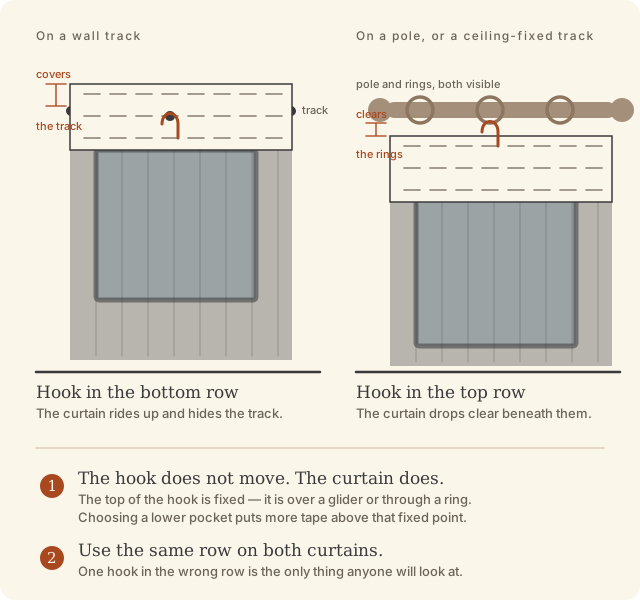
Think about where the hook is anchored. The top of the hook does not move — it is over a glider or through a ring, and that is fixed. Everything else hangs off it. So:
- Hook in the bottom row → more tape sits above the fixed point → the curtain rides higher, and its top comes up level with or above the track. This is what you want on a wall-fixed track, because the curtain then hides it.
- Hook in the top row → almost no tape above the fixed point → the curtain hangs lower, clear beneath the rings. This is what you want on a pole, which is meant to be seen.
A ceiling-fixed track behaves like a pole, not like a wall track: there is nothing above it to hide, so the top row is right there too. That matters here more than it does anywhere else, because a false ceiling usually means the track is fixed into the ceiling or into a pocket in it.
Get this backwards and the symptom is unmistakable — a strip of white plastic showing the whole way along above the curtain, or a curtain climbing up and swallowing the rings. Both are a five-minute fix and neither needs anything bought.
Use the same row on both curtains of a pair. One hook in the wrong row hangs its pleat below its neighbours, and on a plain fabric that is the only thing anyone will look at.
Spacing, and the hooks at the ends
Published guidance is consistent, and it is looser than people expect:
- Roughly every 8 cm, or one hook in every fourth pocket — "hook one, miss three" is how it is usually said.
- Simpler still: half as many hooks as you have rings or gliders, which is the rule most retailers give and the easiest to check on the floor.
- What matters far more than the number is that the gaps are equal. Unequal spacing shows as unequal pleats down the whole drop. And gaps that are too wide let the curtain sag between the hooks, which is the real cause of a droopy heading.
Two hooks earn their own mention. The outside-edge hook goes at the very end of the tape, not a little way in — it is what anchors the closed curtain at the end of the track. At the leading edge, the one that meets its partner in the middle, set the hook so the two panels overlap properly when closed rather than meeting exactly; a curtain pair that just touches will show a line of light down the centre.
If you are using pleater hooks, count first: you need as many rings or gliders as you have pleats, and finding that out after the curtain is up is a bad afternoon.
How to actually get them in
For slide-in hooks on pencil pleat tape: draw the cords up to the finished width first and tie them off — never cut them, the curtain has to be let out flat to be washed. Then insert the hooks into the pockets, not onto the cords. This is the mistake even the manufacturers’ own instructions call out, and it is easy to make because the cords sit right there behind the pockets and will hold a hook for about a week.
For pleater hooks: one prong per pocket, into as many adjacent pockets as the hook has prongs, pinching the fabric together as you go. Then push the whole hook up and over, so that the prongs finish at the front of the curtain pointing downwards. Pocket pitch varies by tape, and the gap between pleats is usually three pockets skipped — roughly three to five inches of flat tape between one pleat and the next.
For pin hooks: the prong goes up into the buckram, the stiff band inside the heading, and must not come through the front of the fabric. Where you enter is what sets the drop — higher up the pleat lengthens the curtain, lower shortens it, exactly like the pocket rows. So mark the height once and use it for every hook on both panels.
And whichever you are using, lay the curtain out flat and put the hooks in along a straight line rather than doing it while the curtain hangs. A quarter-inch of variation between hooks reads as a sloping hem across the room.
What changes on a Hyderabad window
Most instructions for this are written for a pole on a plain wall, which is not what is above the window in a flat here.
The pelmet box is still the default. A boxed enclosure above the window, a track inside it, no visible hardware. Inside a pelmet the height rule loosens — the box hides the top of everything — but the hook row still decides whether the curtain clears the bottom edge of the pelmet or falls an inch short of it, and that inch is exactly where the morning light comes through.
No pelmet, and the track shows. The commoner case in new flats, and a whole article of its own. Check the hook row before spending money on a fix — a good share of the time the track is on show only because the hooks went into the top row.
Ceilings run ten to eleven feet. Moving a hook down a row buys an inch or two, not a foot. A ready-made curtain cut for a seven-foot drop cannot be rescued this way, and one finishing six inches above the floor reads as a mistake from the doorway. That is a made-to-measure question, not a hook question.
Mesh, grill and a sliding sash sit between the glass and the cloth. Nearly every window here carries a mosquito mesh panel, and lower floors an MS safety grill. They decide how far the track has to stand off the wall, which is a bracket problem rather than a hook one — but it is the usual reason a sheer on the inner track catches and drags, and no amount of moving hooks will fix that one.
Two tracks, not three. The arrangement here is a sheer nearest the glass and one lined curtain in front of it, with the blackout stitched into the back of that curtain as a lining. So there are two sets of hooks to get right, and the sheer’s are the ones people rush. A sheer hung a row out from the curtain in front of it shows through.
Sun on the heading, eight months a year. Plastic hooks go brittle under UV, and the top of a curtain in a west-facing Hyderabad living room gets more of it than most. On a sheer they are fine. Under a blackout-lined curtain on an eleven-foot drop, metal is worth the very small extra — that is trade practice rather than a published rating, but it is what the weight and the light here argue for.
When hooks are not the answer at all
Some headings do not take hooks, and forcing it is how tape gets torn.
Eyelet or grommet curtains. Metal rings punched through the fabric, and the pole passes straight through them. No hooks, no rings, no tape — which is why plenty of people never meet a curtain hook at all, since eyelet is the heading most ready-made curtains here are sold with. The one exception is the S-hook above: an eyelet curtain can go on a track, hanging from an S-hook on each glider, because the eyelets are too wide to sit on the gliders themselves.
Rod-pocket curtains. A sewn channel at the top that the pole threads through. No hooks, and no way of drawing them properly either.
Wave and ripplefold headings. A proprietary tape and carriers that come with the track, spaced by the system rather than by you. The gliders do the work a hook would.
If your curtain is one of these and somebody has sold you a packet of hooks, they have sold you the wrong thing.
We measure, make and hang curtains ourselves, and we stock the tracks, rods and the hardware that goes with them — so if you bring in a curtain and a packet of hooks that do not go together, somebody here will tell you in under a minute. The showroom is on Road No. 12, Banjara Hills: House No 536, first floor, NBT Nagar, opposite the Triumph showroom, Monday to Saturday, 11am to 8.30pm. A site visit is ₹500, and it comes off the bill if you go ahead.
Still stuck? Send a photograph of the window on WhatsApp and we’ll tell you what will and won’t work. Or read more about tracks, rods & accessories.
This is the point where a measurement usually matters more than a preference. If you’d like us to look at it properly, start here.
Send a photo of the window — it usually tells us more than a description.
Read next
- Made-to-measure curtains in Hyderabad
Ready-made drops are cut for shorter rooms. Why ceiling height, builder variation and fullness usually decide this here, long before taste does.
- Your curtain track is showing. Here are the two fixes.
No pelmet and a bare white track above the window? There are two ways out, and one very common mistake.
- Curtain tracks, pelmets and motors in Hyderabad
Pelmet box, false-ceiling pocket or a rod meant to be seen — the hardware above the curtain decides whether the room reads finished.
NBT Nagar, Banjara Hills, Hyderabad 500034+91 96769 21216