
Living room curtains in Hyderabad
Aakriti Nagpal · 29 August 2026 · 7 min read
Ceiling height, balcony sliders and the afternoon sun decide a living room curtain here, long before the cloth does — and four rooms we get asked about most.
A living room curtain in Hyderabad is decided by the building, not by the catalogue. Ceiling height, a balcony slider, a lintel that does not line up with the next one along, and the afternoon sun on a west wall. Style is what you choose after those four have been looked at in person.
This is the general case. Underneath it, four articles cover the specific rooms we are asked about most, and they are linked at the end.
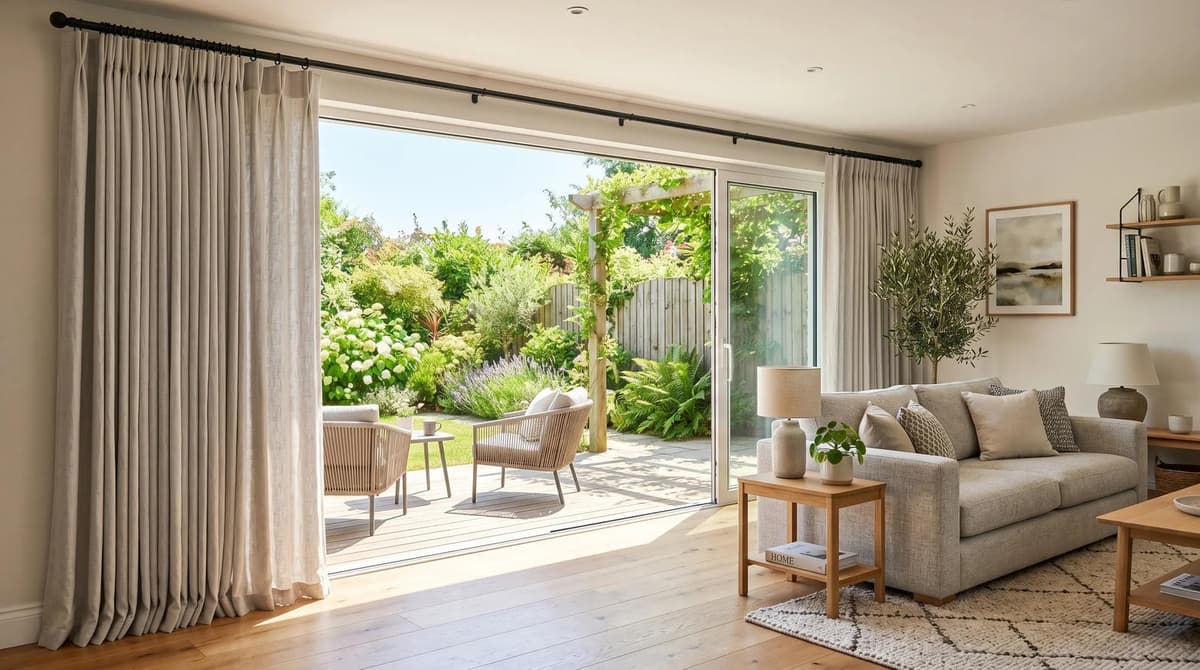
Why the living room is a different job
It is the room people sit in during the day, so light control has to work at eleven in the morning and again at five in the afternoon. It is also the room with the largest run of glass in the flat, which means stack-back and track length matter more here than anywhere else.
Four things are being solved at once, and they pull against each other:
- Style — the cloth should sit with the furniture, not fight it.
- Light — a sheer for daylight, a heavier pair or a dimout for when the west sun arrives.
- Privacy — ground-floor rooms, and towers that look into each other, need more than a pretty weave.
- Heat — a lined curtain on the glass is one of the cheaper ways to stop the air conditioning chasing a hot window all afternoon.
What is different about a Hyderabad living room
Four things come up on nearly every job here, and none of them appears in general curtain advice.
The ceilings are taller than the curtains you can buy. New towers across the western corridor run ten to eleven feet floor to ceiling, and a lot of them are floor-to-ceiling glazed as well. Ready-made panels are cut for a seven- or eight-foot drop. Hang one in a room like that and it stops two or three feet short of where the eye expects it to stop — which reads as a mistake even to somebody who could not say what is wrong.
Almost every living room opens onto a balcony. That sliding door is used daily, and a curtain that does not clear its leading edge becomes something you fight every time you step out. The track has to run wide enough past the opening for the stack to sit clear of the glass, which usually means the track is noticeably wider than the door.
The walls are concrete, not timber. There is nothing to screw into. Fixings go into a drilled and plugged hole, and a track carrying eight feet of lined fabric that was plugged badly does not fail quietly — it comes away with a patch of plaster. This is the single most common reason a curtain has to be redone in a new flat.
And the afternoon is the design problem. A west or south-west living room takes several hours of direct sun at the hottest part of the day. Fabric choice, lining and layering all follow from that rather than from the colour scheme. What it takes to live with the afternoon is the whole system written up.
Measure the room you have
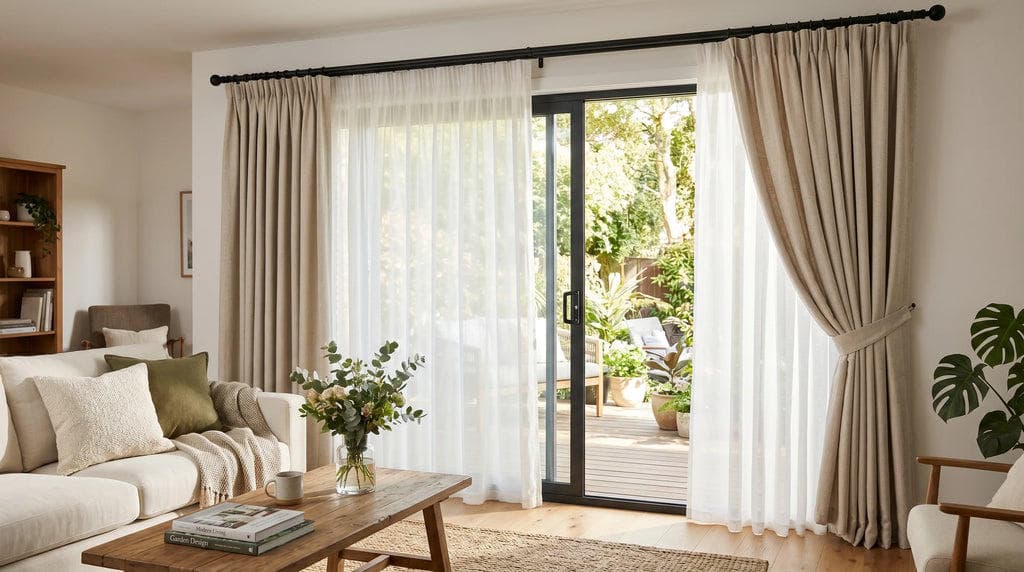
Living rooms here are often a slider plus a fixed pane, or a slider plus two windows that were not set at the same height. Treat them as one elevation. A separate pair on each opening leaves a bright vertical gap and a clutter of overlapping hems.
Run the track past the frame so the stack sits on the wall. If there is no wall — a glass corner, a tight reveal — that is a blinds conversation, not a curtains conversation.
Fullness is not a flourish. Ask any quote how many panels it has allowed and what lining sits behind them. A curtain cut to the exact width of the window looks skimpy when it is closed and never quite meets in the middle, and two quotes that differ by half are usually not quoting the same number of panels. That is most of what separates made-to-measure from a ready-made drop.
We measure the window, not the drawing. Builder openings in this city are often an inch off the plan, and an inch off is a remake.
Headings, cloth and layering
Floor-to-almost-ceiling is the default in a room with ten or eleven foot ceilings. The hem should kiss the floor or break by a centimetre — puddling photographs well and collects dust here.
Contemporary flats with a long run of glass take wave on a concealed track, which is the cleanest thing you can do to sixteen feet of slider. Older apartments and houses with a proper cornice take pinch pleat, which holds a more tailored fold and needs more room to stack. Eyelet on a visible rod is honest in a room where the hardware is meant to be seen, and the least forgiving if the drop is wrong.
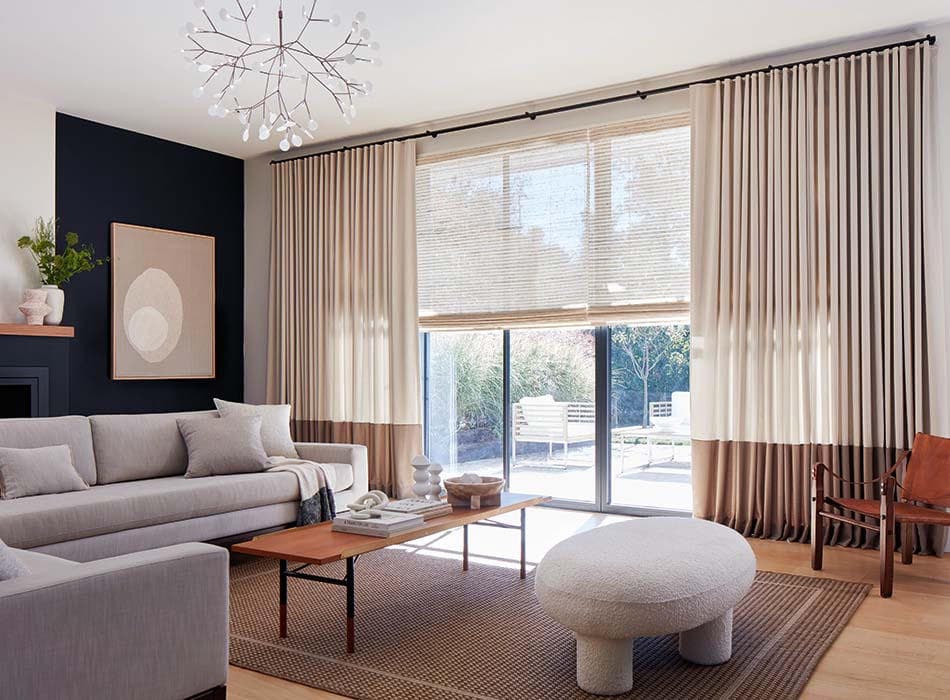
Linen and linen blends do the most work in Hyderabad living rooms — they soften west light without shutting the room down. A denser weave or a velvet is for the window that bakes.
Sheer on the inner track, heavier cloth on the outer. A double track costs more than a single rod; it also stops you having to choose between a pretty curtain and a useful one. Mixing two fabrics on one rod looks unresolved. And a bare white track with no pelmet and no cover is the most common unfinished look in this city — there are two ways to fix it, and one of them does not need the ceiling opened.
Colour and pattern
Warm neutrals — oat, flax, stone, clay, a dusty olive — are what most Hyderabad living rooms can live with through summer and wedding season alike. White linen is beautiful in a photograph and unforgiving with monsoon dust.
Texture does more work than print in this climate. Pattern is fine on a single window and risky on a sixteen-foot slider, where the repeat has nowhere to hide. If the sofa is patterned, the curtain should not be.
When a drape is the wrong idea
Small windows with no stack wall. Wet balconies where fabric will wick. A kitchen-facing opening that gets oil in the air. Those are blinds — a roller or a Roman inside the reveal — with a dress curtain either side only if there is wall to park it.
We sell both. We would rather tell you the curtain is wrong than hang one that fights the room.
Which of these is your room
The advice above is general on purpose. The useful version depends on which window you actually have:
- A west-facing living room — the hardest one, and the one with the most to gain from layering.
- An east-facing living room — a different problem: strong early light, then nothing.
- An open-plan living and dining space — where windows of different sizes have to look like one decision.
- A small apartment living room — where stack-back matters more than anything, because the fabric has nowhere to go.
We measure, make and hang curtains ourselves, from the showroom on Road No. 12, Banjara Hills — House No 536, first floor, NBT Nagar, opposite the Triumph showroom, Monday to Saturday, 11am to 8.30pm. Come and see the cloth in daylight, which is the one thing a screen will not do for you. A site visit is ₹500, and it comes off the bill if you go ahead.
Still stuck? Send a photograph of the window on WhatsApp and we’ll tell you what will and won’t work. Or read more about curtains.
This is the point where a measurement usually matters more than a preference. If you’d like us to look at it properly, start here.
Send a photo of the window — it usually tells us more than a description.
Read next
- West-facing living room curtains in Hyderabad heat
Exact measurement guide and layering system that actually blocks afternoon sun in west-facing living rooms. Practical advice for Hyderabad homes.
- East-facing living room light control
Sheer and dimout combinations with exact measurements, for an east-facing living room that has to take the Hyderabad morning without going dark.
- Open-plan living & dining window treatments
Curtains and blinds that separate a living and dining area gently, light each zone differently, and still let the space read as one room.
- Small apartment living room curtains & blinds
Track calculations and low stack-back for living rooms under 12×14 ft, so an open curtain stops eating the wall the room cannot spare.
NBT Nagar, Banjara Hills, Hyderabad 500034+91 96769 21216