
False ceiling in Hyderabad
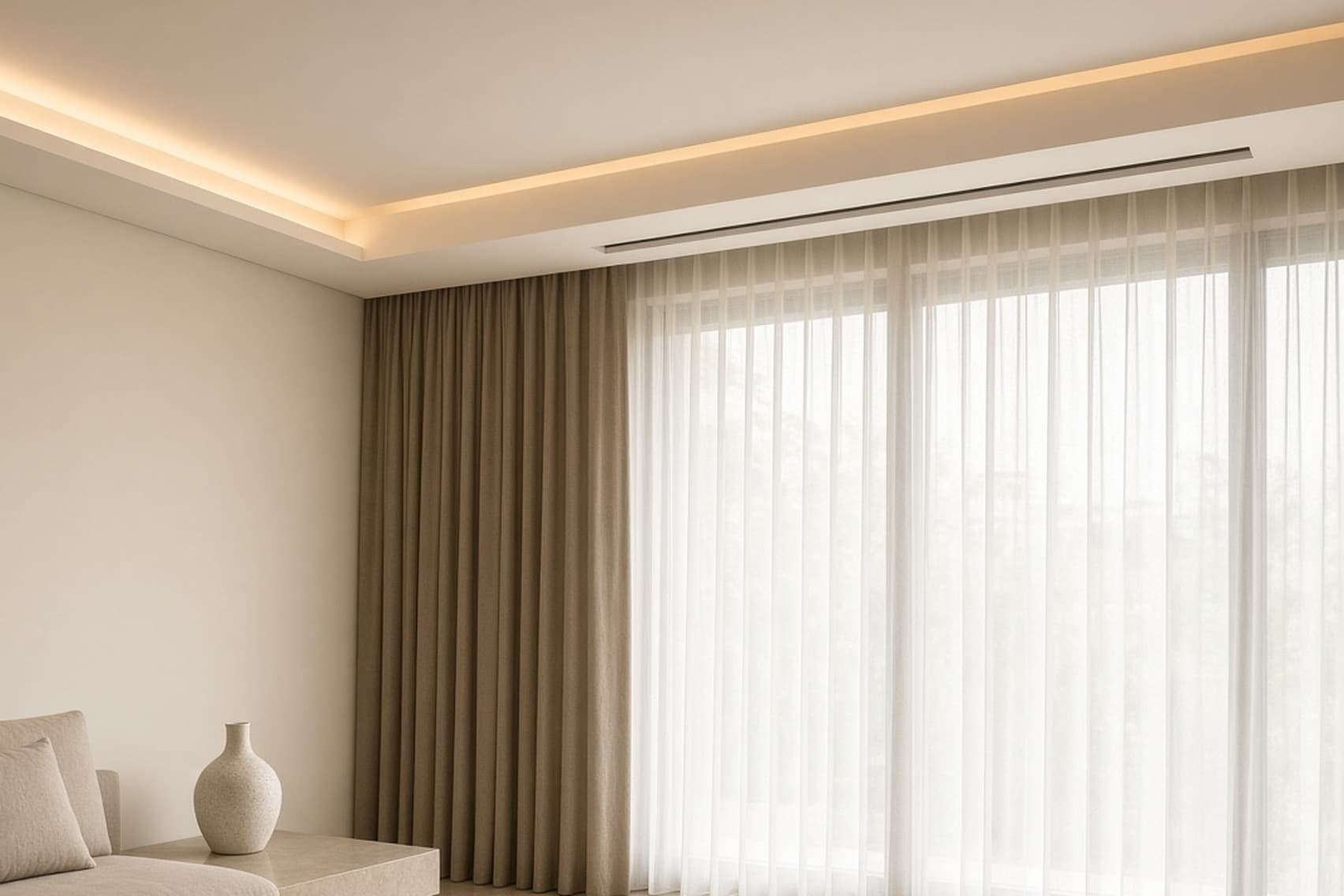
Where the wiring, the lights and the curtain track get sorted out
A false ceiling — most people here say fall ceiling, and mean the same thing — is a second ceiling hung below the slab. It hides wiring and ducting, carries the lighting, and is the one chance to put a pocket in for a curtain track before anyone thinks about curtains.
What we take on
Gypsum board
Factory-made board on a metal frame. Flat, fast and the standard for most rooms.
best for living rooms, bedrooms, anywhere wanting a clean plane
POP
Mixed and worked on site, so it takes curves and mouldings gypsum cannot.
best for shaped ceilings and cornice work
Grid and mineral fibre
Lay-in tiles on an exposed grid, so any tile lifts out for access.
best for offices, clinics and anywhere with services above
PVC panels
Takes damp without swelling and wipes clean.
best for bathrooms, utility areas and balconies
Wood and veneer rafters
Slats or beams under the ceiling, warm against a flat plane.
Cove and profile lighting
The lighting is the reason for most of it — cove, profile, spots and the pockets they sit in.
A cove throws light up at the slab and bounces it back, which fills a room without a bright source in your eye. Profile light sits flush in a channel and reads as a line rather than a fitting. Both have to be drawn before the board goes up.
Curtain pockets
A recess for the track, so the hardware never shows.
This is the detail most ceilings get wrong, because the ceiling and the curtains are usually done by two different contractors who never speak. The pocket has to be deep enough for the track and the bracket, wide enough for the fabric to stack, and it needs a power point in it if the track is ever going to be motorised.
Which one do you need?
“Where does the curtain track go?”
Into a pocket in the ceiling, decided now rather than later. We do both halves of this, which is the whole reason to ask us — the pocket gets the depth the track needs, and a power point above it if there is any chance of motorising later. Retrofitting either means opening the ceiling again.
“Does a false ceiling reduce heat?”
A little, and less than people hope. The air gap slows heat coming down through the slab, which is worth something on a top floor. It does nothing about the sun coming through a west window, and that is where most of the heat in a Hyderabad living room arrives — which is a curtain and blind problem, not a ceiling one.
“Gypsum or POP?”
Gypsum for anything flat: it is made in a factory, so it is consistent, and it goes up faster with less mess. POP where the design curves or wants a moulding, because it is worked by hand on site. Most jobs use gypsum for the plane and POP for the detail rather than choosing one outright.
“Which one is best for a flat here?”
Gypsum on a metal frame, for almost every room in almost every flat in Hyderabad — it is flat, it is consistent, and every electrician and painter in the city knows how to work with it. The exceptions are worth knowing: PVC in a bathroom or a utility balcony, because damp does not bother it; POP where the design actually curves; a grid where something above the ceiling will need reaching again. The material is rarely the interesting decision. How much of the room you drop, and where the light and the curtain track go, is.
“There are pipes and wiring above it”
Then decide now how you get back to them. Gypsum and POP close the ceiling permanently: reaching a leaking joint or a dead junction box afterwards means cutting a hole and making it good. A grid ceiling gives that up in looks and gets it back in access, because any tile lifts out by hand. The middle answer, and the usual one in a home, is a gypsum ceiling with an access panel put in over the valve or the box that will need it — which is only possible if somebody says where they are before the frame goes up.
“The last one cracked”
Cracks come from the frame, not the board — spacing too wide, or joints that were taped rather than jointed and sanded properly. It is worth knowing before you agree a rate, because it is the part of the job you cannot see once it is painted.
“The ceiling is already low”
Then do not drop the whole thing. A peripheral ceiling around the edge of the room carries the lighting and the curtain pocket and leaves the middle at full height, which is what most flats here need.
“We want a fan as well as the lights”
Say so before the frame goes up. A fan hangs off the slab through the false ceiling, never off the board, and the rod length has to be worked out against the new ceiling height rather than the old one.
Talk it through
Measurements are the part most people get wrong, and a wrong measurement usually means a remake. Send a photograph of your ceiling and we’ll tell you exactly what we need to see. The showroom is open Monday to Saturday, 11am – 8.30pm, or answer six questions and we’ll call you back knowing what you need.
Send a photo of your ceiling — it usually tells us more than a description.
We come to you, measure and bring samples. The visit is ₹500, and it comes off your final bill if you go ahead.
Rated 5.0 from 146 reviews on Google. Read them.
Before you commit
Warranty, cancellation, and what we do and do not take on — answered in the questions people ask, in Sanchith’s words, including where the answer is no.
Related
NBT Nagar, Banjara Hills, Hyderabad 500034+91 96769 21216