
Made-to-measure curtains in Hyderabad
Aakriti Nagpal · 29 August 2026 · 6 min read
Ready-made drops are cut for shorter rooms. Why ceiling height, builder variation and fullness usually decide this here, long before taste does.
Ready-made curtains are cheaper, available today, and right for some windows. But they are cut for a different market — seven- and eight-foot ceilings, fixed widths, a heading that only works on a thin rod. New flats across Hyderabad run ten to eleven feet, and plenty of rooms are floor-to-ceiling glazed.
Made-to-measure is not a luxury add-on in this city. It is how you get a curtain that meets the floor, covers the glass when it is closed, and still stacks off the window when it is open. Taste comes after that.
What “custom” actually means on this job
It is not a moodboard. It is a set of decisions that have to be written down before anyone cuts cloth.
- The drop — from the track or rod to where the hem should sit. Kiss the floor, or a one to two centimetre break. Puddling looks good in a photograph and collects dust in this city.
- The width and the fullness — how many panels the window takes. A panel is roughly one width of fabric. Two quotes that differ by half are usually not quoting the same number of panels.
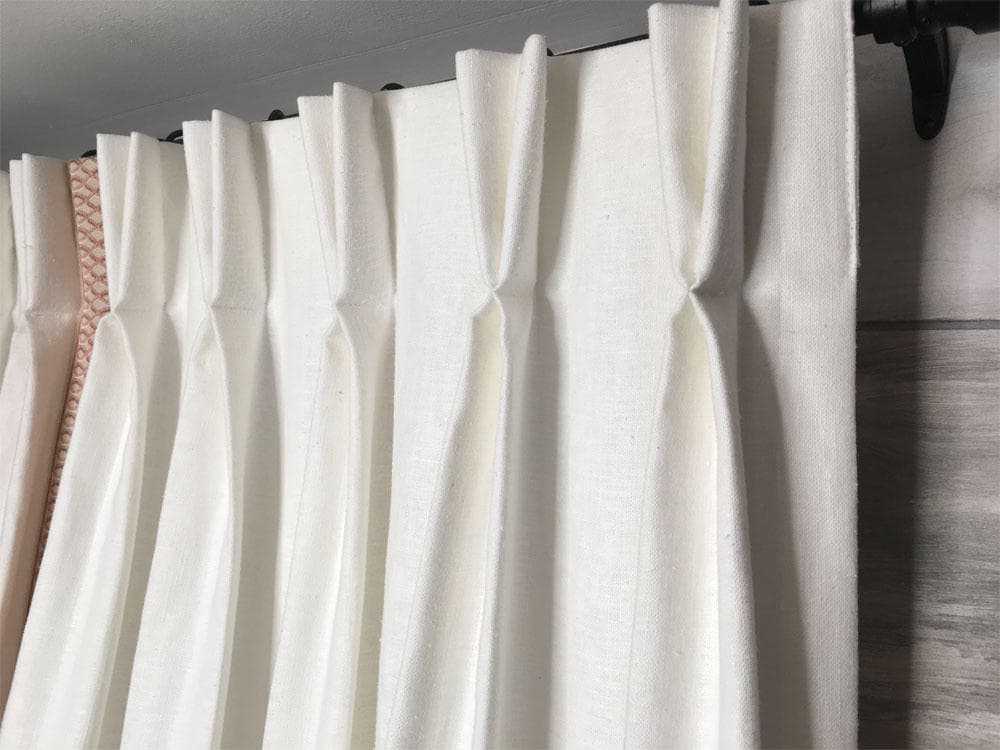
- The heading — pinch pleat, wave, or eyelet. Each hangs on a different track or rod, and each stacks differently.
- The lining — sheer, dimout or blackout, and whether the face cloth needs an interlining as well.
- The hardware — a concealed track, a visible rod, a double track if you are layering.
We measure the window, not the drawing. Builder openings here are often an inch off the plan, and an inch off is a remake.
Fit is the whole point

Off-the-shelf panels force a compromise on every odd window in the house: a bay, an arch, a sliding door wider than two ready-made widths, a lintel that sits higher than the next one along. Made-to-measure takes those as the starting point rather than as exceptions.
The sequence is simple enough. Measure the opening and the wall either side. Decide how high the track sits — closer to the ceiling makes the room read taller. Decide how far the track runs past the frame, so the stack sits on the wall and not on the glass. Then cut for fullness. A curtain that is the exact width of the window looks skimpy when closed and never quite meets in the middle.
Gaps at the edges are where the afternoon light and the dust come in. A proper return at the wall, and a lining that reaches the hem, close those gaps.
Why the answer is usually made-to-measure in Hyderabad
Three practical reasons, none of them about taste.
The drops are wrong. Ready-made panels are manufactured to standard lengths built around seven- and eight-foot ceilings. New flats across this city run ten to eleven feet, and plenty are floor-to-ceiling glazed. A standard panel in a room like that finishes well short of the floor, and a curtain that stops early is the one thing everybody notices and nobody can name.
Two flats on the same floor are not the same. Builder tolerances mean windows in the same tower, on the same floor, can differ by an inch or more — and reveals, pelmet boxes and existing tracks vary more than that. A ready-made panel fits a drawing. It does not fit the opening you actually have, which is why measuring on site is a separate job from choosing fabric.
Fullness is what makes a curtain look like a curtain. A panel needs to be considerably wider than the window it covers, or it hangs flat and reads as a sheet rather than a curtain. Ready-made panels are cut narrow because fabric is the cost. This is the difference people see immediately in a finished room and almost never identify — it is not the fabric, it is how much of it there is.
There is a real counter-argument. On a small standard window, in a rented flat, or where the room is changing again in a year, ready-made is the sensible buy and we will say so. The place made-to-measure earns its cost is a tall window, an odd opening, or a room you intend to live in for a decade.
Fabric, colour and heading — after the fit
Once the size is honest, the cloth can do the rest. Linen and linen blends for rooms that should stay soft in daylight. A tighter weave or a velvet when the window faces west and the sun sits on the glass from three o’clock. A sheer in front of a dimout or a blackout when you want the room to work at two different times of day.
Pinch pleat holds a formal fold and needs enough stack-back. Wave on a concealed track is cleaner on a long run of glass. Eyelet is the simplest to live with on a visible rod, and the least forgiving if the drop is wrong.
What the lining is for
The lining is doing more of the work than the face cloth, and it is the part people decide last.
- Sheer — daylight stays, the view in is blurred. Fine for a garden-facing living room. Weak at night, once the lamps are on.
- Dimout — most of the light goes. The room does not go black. Good for living rooms and studies.
- Blackout — the cloth itself passes no daylight. Light still sneaks around the edges, which is why wide-width fabric and a proper return matter on a tall window.
Insulation is real, but modest. A lined curtain cuts the blast of heat off the glass and helps the air conditioning hold a room. It will not replace a decent AC, and anyone who tells you otherwise is selling the lining.
Motorisation, only where it earns its place
A motorised track is worth it on a high window you cannot reach, on a long run of glass, or when two people in the house will never agree on whether the curtains are open. It is not worth it on a single bedroom window you walk past every morning.
Before you decide either way
Two things worth reading: what to do when there is no pelmet, because the track is visible in most new flats and it changes the heading you choose; and the small-apartment case, where the width of the stack when the curtain is open matters more than anything about it when closed.
We make curtains ourselves — the people who quote the job are the people who see it hung. The showroom is on Road No. 12, Banjara Hills: House No 536, first floor, NBT Nagar, opposite the Triumph showroom, Monday to Saturday, 11am to 8.30pm. A site visit is ₹500, and it comes off the bill if you go ahead.
Still stuck? Send a photograph of the window on WhatsApp and we’ll tell you what will and won’t work. Or read more about curtains.
This is the point where a measurement usually matters more than a preference. If you’d like us to look at it properly, start here.
Send a photo of the window — it usually tells us more than a description.
Read next
- Your curtain track is showing. Here are the two fixes.
No pelmet and a bare white track above the window? There are two ways out, and one very common mistake.
- Small apartment living room curtains & blinds
Track calculations and low stack-back for living rooms under 12×14 ft, so an open curtain stops eating the wall the room cannot spare.
- How to hang curtains with hooks
Which row of pockets you put the hook in decides how high the curtain hangs. The rule, the spacing, and what changes on a Hyderabad window.
- Curtain fabrics in Hyderabad
What the cloth is made of, when blackout earns its cost, how 3.0 fullness is calculated, and which heading belongs on which Hyderabad window.
NBT Nagar, Banjara Hills, Hyderabad 500034+91 96769 21216