
East-facing living room light control
Aakriti Nagpal · 17 August 2026 · 5 min read
Sheer and dimout combinations with exact measurements, for an east-facing living room that has to take the Hyderabad morning without going dark.
East-facing living rooms receive strong, direct sunlight in the morning, usually from sunrise until about 11:00–11:30 am. Unlike the harsh, heat-heavy afternoon sun of west-facing rooms, morning light is brighter in the visible spectrum but carries less intense infrared heat.
The main problems clients face are strong glare on television screens and seating areas during morning hours, the room feeling washed out or overly bright, difficulty creating a calm atmosphere for morning use, and curtains that are either too heavy (making the room gloomy) or too light (failing to control glare).
The goal is not to block the light completely during the day, but to soften and control it while retaining the fresh, bright character that east-facing rooms naturally have.
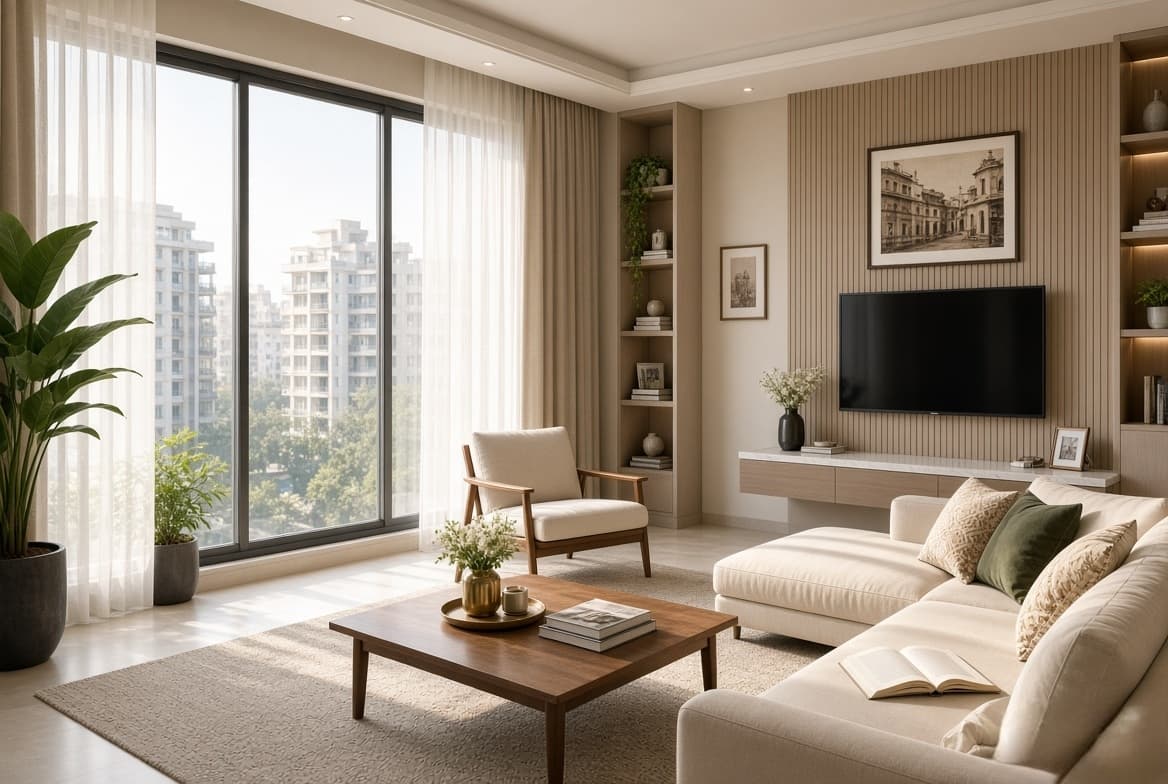
Recommended Approach: A Two-Track System
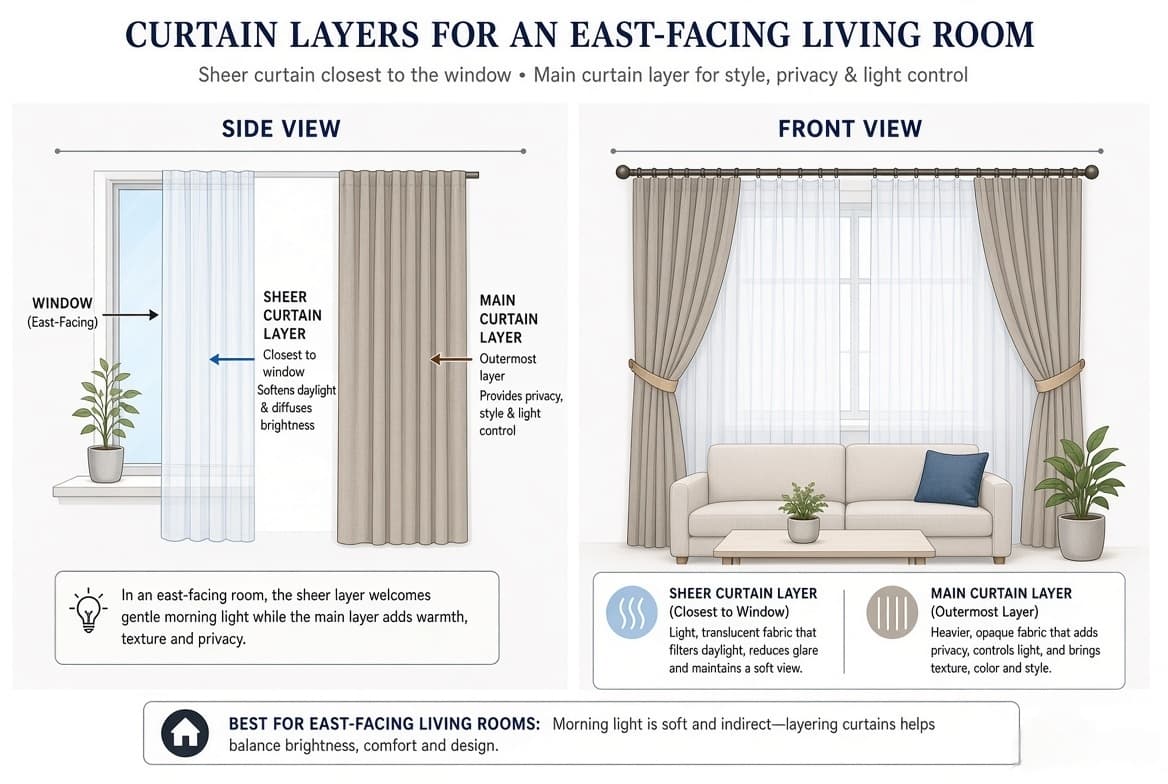
For most east-facing living rooms, two tracks do everything you need:
- Sheer layer (closest to the glass) — the primary daytime solution
- Decorative curtain, lined — one curtain on the second track, with a dimout or light blackout lining stitched to its back facing the window. For evenings, privacy, and occasional strong glare control.
A heavy blackout lining is less critical than in west-facing rooms, since morning light carries less heat — but it is still worth it for clients who watch films during the day or want complete privacy at night.
Exact Measurement Guidelines
Measurement principles remain similar to other rooms, with a few east-specific adjustments.
Width
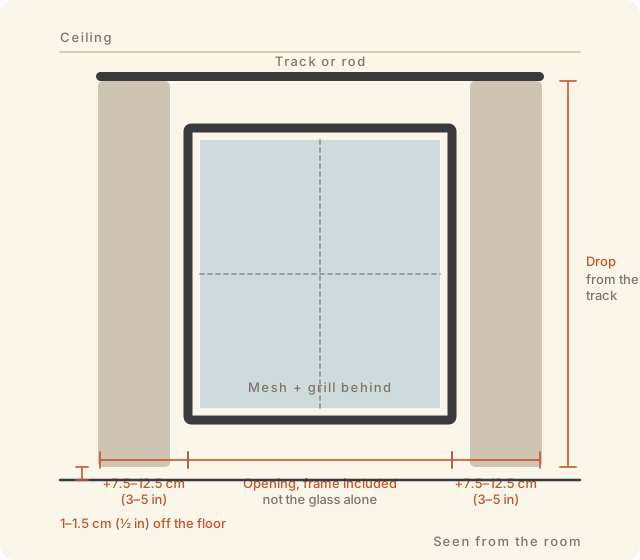
Measure the full width of the window opening including the frame. Add 15–25 cm (6–10 in) in total — 7.5–12.5 cm, or 3–5 in, on each side. East light is higher in the sky, so extreme side coverage is slightly less critical than for west windows, but still recommended for a polished look and better evening privacy.
Drop / Height
Ceiling mount is still preferred for a taller, more elegant appearance. Finished length should kiss the floor (1–1.5 cm clearance) or have a very slight break. Puddling is rarely practical in living rooms.
Track depth
Double track is ideal. Allow 12–15 cm (5–6 in) clearance from the wall or glass so both layers can stack and move freely.
Fabric Choices That Work Best
Sheer layer (the most important layer for east-facing rooms)
Openness factor between 3% and 8% gives excellent glare reduction while still keeping the room bright. Avoid pure white sheers if the morning sun is very strong — they can create a harsh white glare. Soft ivory, warm white, or very light grey perform better. Polyester or polyester-linen blends are practical for Hyderabad dust and are easy to maintain.
Main curtain layer
Medium weight (250–320 GSM) is sufficient. You can choose lighter colours than you would for a west-facing room because heat build-up is lower. A dimout lining (not full blackout) is often ideal. It softens light significantly without making the room cave-like when closed during the day.
Where true blackout is wanted
If the client wants real darkness (for afternoon naps, movie watching, or shift workers), specify a proper blackout lining on the main curtain rather than adding another curtain. The lining is stitched to the back of that curtain, facing the sun, so it needs no track of its own.
Practical Layering Combinations
Combination A (Most Popular)
Sheer + medium-weight decorative curtain with dimout lining. Gives excellent daytime control and good evening privacy.
Combination B (Maximum Flexibility)
Sheer + decorative curtain with a blackout lining, plus a blackout roller blind inside the reveal. The blind is an addition to the system rather than another layer of it, and it is what gives true darkness at odd hours — without a third track or a third stitching charge.
Combination C (Budget-Conscious)
High-quality sheer with a good dimout or light blackout curtain only. Skips the separate decorative curtain if the budget is tight, while still delivering strong functional performance.
Installation and Operation Tips
Stack the sheer to one side or both sides depending on furniture layout. Many east-facing rooms benefit from stacking the sheer completely clear of the glass in the late morning so the full brightness can enter once the direct sun has moved higher.
Use a continuous track or well-aligned separate tracks so the layers move smoothly. If motorisation is planned, the sheer is often the most frequently used layer and benefits most from motorised operation.
Common Mistakes Specific to East-Facing Rooms
- Installing heavy blackout curtains as the only layer — the room becomes unnecessarily dark in the mornings.
- Choosing sheers that are too open (above 15–20% openness) — they fail to control glare on television screens.
- Mounting the track too narrow, so morning light still floods around the edges onto the seating area.
- Using the exact same specification as a west-facing room, which usually results in an overly heavy treatment.
Client-Specific Adjustments
Work-from-home clients
Prioritise glare control on the desk or seating area. A well-chosen sheer is often more important than full blackout.
Families with young children
Morning light is usually welcome. Focus on easy-to-operate layers and fabrics that tolerate frequent handling.
Clients who prefer a bright, airy feel
Lean towards lighter decorative fabrics and higher-quality sheers rather than heavy blackouts.
Homes with large east-facing sliding doors
Treat the entire glass wall as one system. Continuous tracks or carefully planned overlapping panels prevent light gaps when the doors are closed.
Final Recommendation
East-facing living rooms reward a lighter, more flexible approach than west-facing ones. The priority should be excellent daytime glare control through a high-quality sheer, supported by a good secondary layer for privacy and evening use.
When measured and specified correctly, the room stays bright and pleasant in the morning while remaining comfortable and private at all other times.
For precise fabric quantities, track specifications, and samples suited to your exact window sizes and interior style, a professional measurement visit is the most reliable next step.
Still stuck? Send a photograph of the window on WhatsApp and we’ll tell you what will and won’t work. Or read more about curtains.
This is the point where a measurement usually matters more than a preference. If you’d like us to look at it properly, start here.
Send a photo of the window — it usually tells us more than a description.
Read next
- West-facing living room curtains in Hyderabad heat
Exact measurement guide and layering system that actually blocks afternoon sun in west-facing living rooms. Practical advice for Hyderabad homes.
- Master bedroom blackout system for deep sleepers
The measurements that make a master bedroom genuinely dark — side coverage, centre overlap and hem clearance, not just a fabric labelled blackout.
- Living room curtains in Hyderabad
Ceiling height, balcony sliders and the afternoon sun decide a living room curtain here, long before the cloth does — and four rooms we get asked about most.
NBT Nagar, Banjara Hills, Hyderabad 500034+91 96769 21216