
West-facing living room curtains in Hyderabad heat
Aakriti Nagpal · 17 August 2026 · 8 min read
Exact measurement guide and layering system that actually blocks afternoon sun in west-facing living rooms. Practical advice for Hyderabad homes.
In Hyderabad, west-facing living rooms receive the strongest and hottest sunlight of the day, typically from 1:30 pm to 5:30 pm. The sun is lower in the sky during these hours, which means the light comes in at a sharper angle and penetrates deeper into the room than morning light.
Most standard single-layer curtains fail here for three reasons:
- They are not dense enough to block the intense infrared heat.
- Light leaks from the sides and top if the mounting is not precise.
- People often choose pale, lightly woven fabrics for how they look, and a thin pale cloth lets more heat and glare straight through.
The result is a living room that becomes uncomfortably warm in the afternoon, forces the AC to work harder, and creates strong glare on television screens and seating areas.
A properly designed system solves all three problems without making the room feel dark or heavy.
The Recommended Layering System
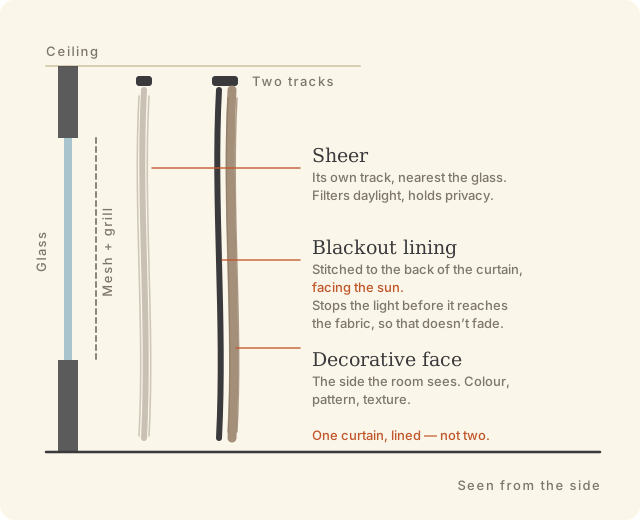
For west-facing living rooms in Hyderabad, the most effective and elegant solution is three layers of fabric on two tracks:
- Sheer layer (closest to the glass) — for daytime privacy and soft light diffusion. This gets its own track.
- Main decorative curtain — for style, colour, and moderate light control. This goes on the second track.
- Blackout or thermal lining — stitched to the back of that curtain, facing the sun. It stops the heat and light before they reach the decorative fabric, which also keeps that fabric from fading.
The blackout is a lining, not a third curtain, so it needs no track of its own. Where budget or space is tight, drop the sheer and use the lined curtain alone. Where a room needs total darkness at odd hours, add a separate blackout blind inside the reveal — that is an addition to the system, not another layer of it.
Exact Measurement Protocol
Accurate measurement is more important than fabric choice. A perfect fabric on a poorly measured track will still leak light and look unfinished.
Step 1: Decide the Mount Type
- Ceiling mount (recommended for most modern apartments and villas): Makes the window look taller and reduces light leak from the top.
- Wall mount above the window: Useful when the ceiling is false (POP) and cannot take heavy weight, or when there is limited wall space on the sides.
Step 2: Measure Width
- Measure the width of the window glass + frame.
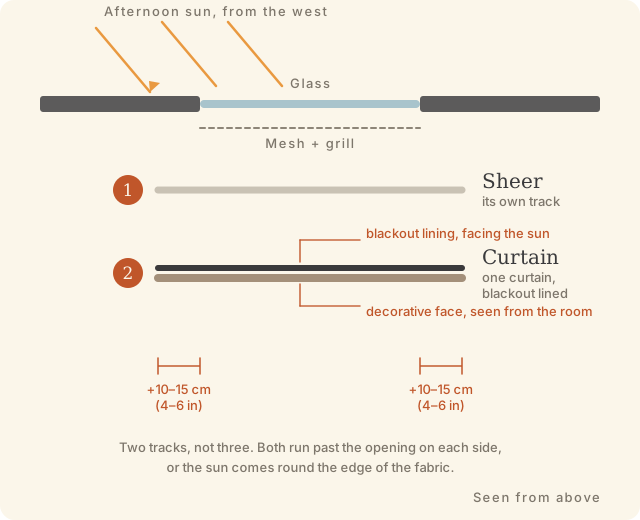
- For ceiling or outside mount, add 20–30 cm (8–12 in) total — 10–15 cm, or 4–6 in, on each side. This extra width is critical for west-facing windows because the low-angle afternoon sun will otherwise come around the edges.
- If you are using a double or triple track, measure the full width you want the tracks to cover.
Record three width measurements: top, middle, and bottom of the window area. Use the largest number.
Step 3: Measure Height / Drop
- For ceiling mount: Measure from the ceiling (or the underside of the cornice) down to the floor.
- Decide the finished length:
- Kiss the floor: 1–1.5 cm above the floor (cleanest and most practical for living rooms).
- Slight break: 2–4 cm (1–1.5 in) of fabric resting on the floor — a more luxurious look.
- Puddle: 8–15 cm (3–6 in) extra (only for formal spaces that are not high-traffic).
For west-facing rooms, “kiss the floor” or a very slight break is usually best. Long puddles collect dust faster in Hyderabad.
Step 4: Track / Rod Considerations
- Single track: Minimum depth clearance 8–10 cm (3–4 in) from wall/glass.
- Double track: 12–15 cm (5–6 in) clearance.
- Triple track: 18–22 cm (7–9 in) clearance.
If your living room has a false ceiling, confirm the POP can support the weight or plan for wall brackets that transfer load to the main wall.
Fabric and Lining Recommendations for Heat
Sheer layer:
- Openness factor 5–10% (allows light but maintains daytime privacy).
- Polyester or polyester-linen blend that is easy to wash.
- Light neutral colours (ivory, soft grey, pale beige) work best so they do not create a colour cast when the sun hits them.
Main curtain:
- Medium-weight decorative fabric (280–350 GSM range is ideal).
- Prefer fabrics with some body so they hang well even when the AC is running.
- Colours: Mid-to-deep tones throw back less visible glare than pure white while still looking refined. Charcoal, deep taupe, muted green, and warm greys perform well.
Blackout / thermal layer:
- Triple-weave blackout or foam-backed blackout lining.
- In Hyderabad heat, a thermal interlining between the decorative fabric and blackout lining gives noticeably better heat reduction.
- Side and top returns (fabric wrapping back to the wall) further reduce light and heat leak.
Practical Installation Details That Make the Difference
- Install the track as close to the ceiling as possible.
- Use returns on both ends of the blackout layer so the fabric touches or almost touches the wall.
- Overlap the centre of the curtains by at least 15–20 cm (6–8 in) when closed.
- If using motorisation, place the motor on the side that is less visible and ensure a manual override exists for power cuts.
Cost and Phasing Reality
A full sheer-plus-lined-curtain system for a typical 3–3.5 metre wide west-facing living room window varies widely depending on fabric tier, heading style, and whether motorisation is included.
Many clients successfully phase the work:
- First install a good-quality blackout or thermal curtain on a proper track. This immediately solves the worst heat and glare issues.
- Add the sheer layer a few months later for daytime privacy and softness.
- Upgrade to motorisation when budget and electrical planning allow.
This staged approach still delivers most of the practical benefit right away while spreading the investment.
Client Variations That Change the Specification
Apartments with false ceilings:
Ceiling mounting may not be possible if the POP cannot take the load. In these cases we shift to strong wall brackets placed higher than the window and use a slightly longer drop. Side returns become even more important.
Homes with large sliding doors leading to a west-facing balcony:
The treatment must cover both the fixed glass and the sliding panels. A continuous track or two carefully aligned tracks work better than separate systems. Floor clearance needs extra attention because balcony dust travels inside.
Families with young children or pets:
Avoid long puddles. Choose fabrics that can be washed or professionally cleaned without shrinking. Cord-free operation (or motorised) is strongly preferred for safety.
Clients who watch television in the afternoon:
Prioritise side coverage and a dense blackout layer. Even a small light gap on the sides creates distracting reflections on the screen.
Rental apartments:
Damage-free mounting options exist. Specialised brackets and temporary solutions can be discussed during measurement so the installation remains reversible.
Additional Practical Hacks
- If the window has a deep recess, consider an inside-mount blackout blind closest to the glass + outside-mount decorative curtains. This combination often gives the cleanest light seal.
- For very wide windows (over 4 metres), split the curtains into more than two panels so each panel is easier to draw and stacks more neatly.
- Ask for a sample of the blackout lining to be held against a bright light or torch. Cheap blackout linings still show pinholes of light.
- In Hyderabad’s dusty conditions, choose tracks with a simple profile that can be wiped easily. Complicated decorative rods collect dust faster.
- If you plan to motorise later, inform the team during the first measurement so the track and stacking side can be planned correctly from day one.
What Good Performance Looks Like After Installation
When the system is measured and installed correctly, you should notice:
- The living room remains comfortable enough to sit in during peak afternoon hours without the AC running at maximum.
- Television and seating areas have significantly reduced glare.
- When the blackout layer is closed, the room reaches a usable dim level even on bright summer days.
- The curtains stack neatly to the sides and do not obstruct walkways or furniture.
- There is minimal light bleed from the top and sides.
If any of these are missing, the issue is almost always measurement, track placement, or insufficient side returns rather than the fabric itself.
Final Recommendation
For a west-facing living room in Hyderabad, prioritise coverage, density, and precise mounting over pure aesthetics. A well-measured, properly layered system will keep the room usable in the afternoon, reduce AC load, and still look intentional and high-quality.
The difference between an average curtain installation and a high-performing one is rarely the fabric brand. It is almost always the accuracy of the measurements, the quality of the track, the presence of proper returns, and the right combination of layers.
When you are ready for exact quantities, fabric options, and track specifications tailored to your specific window sizes, ceiling type, and existing interior, the next step is a professional measurement visit. On-site measurements remove the guesswork and prevent costly mistakes in fabric quantity and hardware selection.
Still stuck? Send a photograph of the window on WhatsApp and we’ll tell you what will and won’t work. Or read more about curtains.
This is the point where a measurement usually matters more than a preference. If you’d like us to look at it properly, start here.
Send a photo of the window — it usually tells us more than a description.
We have done this one
Prestige High Fields, Financial District
A west-facing flat, and what it takes to live with the afternoon. 3 BHK, 15th floor — written up in full, including what we had to sort out.
Read next
- East-facing living room light control
Sheer and dimout combinations with exact measurements, for an east-facing living room that has to take the Hyderabad morning without going dark.
- Open-plan living & dining window treatments
Curtains and blinds that separate a living and dining area gently, light each zone differently, and still let the space read as one room.
- Linen curtains in a Hyderabad home
How linen behaves in Hyderabad — the afternoon sun, the monsoon, and the dust. What to line, what to blend, and where pure linen is worth it.
- Living room curtains in Hyderabad
Ceiling height, balcony sliders and the afternoon sun decide a living room curtain here, long before the cloth does — and four rooms we get asked about most.
NBT Nagar, Banjara Hills, Hyderabad 500034+91 96769 21216