
Curtain tracks, pelmets and motors in Hyderabad
Aakriti Nagpal · 10 September 2026 · 12 min read
Pelmet box, false-ceiling pocket or a rod meant to be seen — the hardware above the curtain decides whether the room reads finished.
Cloth gets the conversation. Hardware does the work.
A 3.0-fullness blackout pair on a ten-foot Hyderabad slider is twelve to twenty kilograms moving twice a day. If the rail is a white builder track screwed into gypsum, it is coming down — and the strip of plastic above the fold will have been the least of it.
We supply and fit tracks. We do not make them, and we say so. The manufacturer’s warranty on a motorised rail passes to you in full and runs for its own term. What we do make is the decision about where that rail sits — wall, ceiling, pocket or pelmet — before anyone cuts a drop.
Three ways the hardware sits
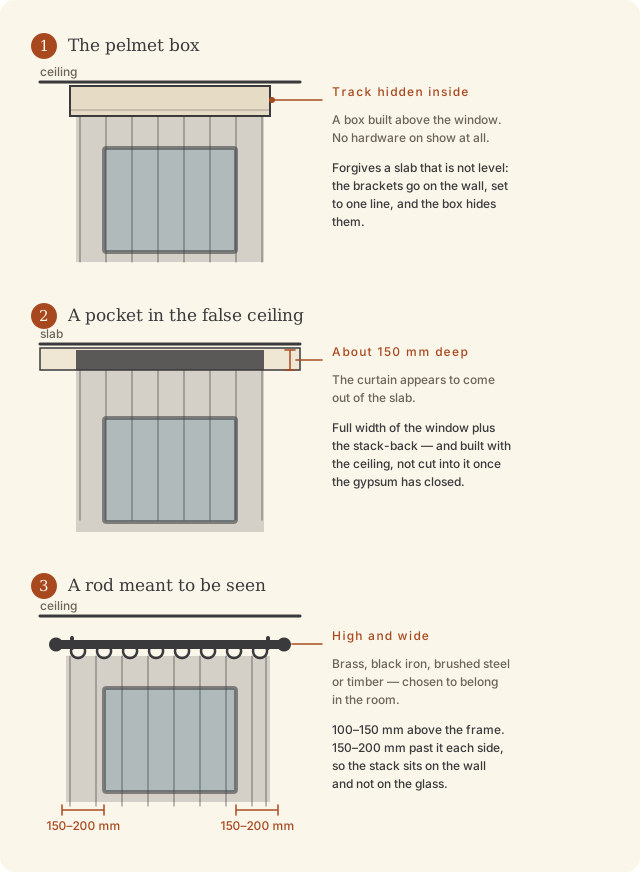
1. The pelmet box
Still the default in a lot of Hyderabad flats: a boxed enclosure above the window, a track inside it, no visible hardware.
Inside a pelmet the height rule loosens, because the box hides the top of everything. But the hook row still decides whether the curtain clears the bottom edge of the pelmet or falls an inch short of it. That inch is exactly where the morning light comes through.
A pelmet also forgives a ceiling that is not level. At My Home Vihanga the slab stepped across the window. A ceiling-fixed track would have given a hem that rose and fell across the room. The brackets moved onto the wall, set to one line, and a pelmet hid them. The curtains fell straight.
That is most of what a soft-furnishing job is: the thing you never notice.
2. A pocket in the false ceiling
The better-looking answer in a new flat, and the one to choose if the ceiling work has not happened yet. A recess, usually around 150 mm deep, running the full width of the window plus the stack-back. The curtains appear to come out of the slab.
Wave headings live here. Pinch pleats live here too, if the pocket is deep enough for the heading to clear.
Tell whoever is doing the ceiling before they start. Cutting a pocket into a finished ceiling means breaking it open, and you will pay for the making good. In Narsingi and Puppalguda this is the usual miss: possession happens, the gypsum closes, and then somebody asks for a hidden track.
3. A rod meant to be seen
If the ceiling is already done, stop trying to hide a white plastic rail. Choose a rod that belongs in the room — brass, black iron, brushed steel, timber. Mount it high and wide: 100 to 150 mm above the frame, and 150 to 200 mm past each side, so the stack sits on the wall rather than on the glass.
At Lore the reception had no provision for a pelmet. Rather than hide the rail badly, we specified a black track and let it read as a line.
The mistake almost everybody makes is leaving the plain white builder’s track exposed and hoping nobody notices. They notice. Not consciously. But a bare track reads as unfinished, because it is — and there are only two honest ways out of it.
Which of the three
Ceiling not yet built — recess it, no contest. Ceiling finished and the room is simple — a slim black or steel rod, high and wide. Ceiling finished and the room has warmth in it — timber or brass. Renting, and you would rather not drill the slab — a rod, every time.
Wall track, ceiling track, pole — and the hook row
The hook does not move. Everything else hangs off it.
- Bottom row of pencil-pleat tape. More tape sits above the fixed point, so the curtain rides higher and the heading covers the rail. This is what you want on a wall-fixed track.
- Top row. Almost no tape above the fixed point, so the curtain hangs clear beneath the rings. This is what you want on a pole, which is meant to be seen. A ceiling-fixed track behaves like a pole, not like a wall track.
Use the same row on both panels of a pair. A quarter-inch of variation between hooks reads as a sloping hem across the room. On a long sunny drop use metal hooks — plastic goes brittle.
The four kinds of hook, and which tape takes which, is a separate piece.
Single track, double track, one run across two windows
Most master bedrooms here end up with two tracks. The inner one carries the sheer. The outer one carries the lined pair. By day the sheer hangs alone; at night the heavy pair is drawn. One window, two behaviours.
- A return of cloth back to the wall at each end. Without it, streetlight comes around the edge no matter how good the blackout lining is.
- An overlap where the two panels of a pair meet at the centre. A vertical slit at midnight is how people decide blackout "doesn’t work".
- Two windows with almost no wall between them get one continuous track, stacking at the outer edges only. Treating them as two jobs leaves a column of cloth in the middle and blocks the light you were trying to keep.
- A balcony slider and its neighbouring window are one run. Leave a bright gap where they meet and the room will never go dark.
What the track has to hold
Fullness is 3.0. A three-metre living-room slider therefore carries about nine metres of flat face cloth, plus lining, plus heading. That is not a curtain pole from a hardware aisle. The arithmetic is here.
| Fixing | Use it when | Do not use it when |
|---|---|---|
| Masonry or RCC wall | Independent house, older flat, a bed wall that is genuinely brick | The "wall" is a gypsum box-out |
| Ceiling slab | Heavy pair, a motor, no reliable wall | Never a reason not to — this is the answer when nothing else is |
| Timber or steel noggin | Fixed back to slab or frame before the board goes on, where the track will sit | It was not put in, and the ceiling is already closed |
| Wall brackets and a pelmet | The slab is out of level, or the rail has to vanish | The pelmet is an afterthought stuck to paint |
Gypsum holds nothing. Not a track, not anything.
This is the one on this page that is not a matter of degree, so it is worth being blunt about. Gypsum board is a lining. It is not a structure, and nothing hangs off it — not a heavy pair, not a light one, not a sheer, not a rod.
The reason is the direction of the load. A track bracket stands off the surface, so the weight of the curtain does not pull straight down the screw. It levers. The curtain hangs forward of the fixing and tries to prise the top screw straight out of the board, which is the one direction board has almost no strength in. Most of what little hold there is comes from the paper face, and the moment that paper tears the fixing has lost most of it. Then it is a slow failure rather than a sudden one: the screw works loose over a few months of drawing the curtain twice a day, the hole ovals out, and the whole run comes off the wall — usually well after handover, usually at night.
Cavity anchors, spring toggles and butterfly plugs do not change this. They spread the same load over a slightly larger disc of the same board. They add area. They do not add structure.
A false ceiling is no better and is often mistaken for better, because it feels solid underfoot of a ladder. It is board on a light-gauge GI channel grid hung off the slab on 6 mm rod. That grid is engineered to carry the ceiling and the ceiling only. Hanging twenty kilograms of moving curtain from it is not what it is for.
So there are two honest fixings and no third. Into solid masonry or the RCC slab. Or into a timber batten or steel noggin that was fixed back to the slab or the frame before the boarding went on, positioned where the track was always going to sit.
Which gives the pocket a second reason to be decided early, and it is the harder of the two. The first reason is that a pocket cut into a finished ceiling means breaking it open. The second is that a pocket with no noggin in it is a void with nothing to screw into — you have hidden the track and removed the only thing that could have held it.
Corded tracks and motors — where they earn the point
Past a certain weight, dragging fabric by hand wears the leading edge and pulls the heading out of shape. The answers are a cord, split at the centre on a wide run, or a motor.
A motor is worth it on a window you cannot reach without a stool. A long run of glass. Two people who will never agree whether it is open. Hospitality rooms that have to look the same every afternoon.
It is not worth it on a single bedroom window you walk past every morning. A guest room. Anywhere the electrician has already closed the ceiling and there is no point at the head.
The motor needs power at the track, and that is decided with the electrician rather than after the gypsum is painted. Touch-motion — a gentle pull starts the run — is the feature people actually use. Voice control is the feature people mention in the showroom and forget.
Ask for the load rating against the real weight of a 3.0-fullness lined pair, not against a sample panel. Motorised curtains and blinds are here if you want the range.
What quality hardware costs
These are 2026 bands for the rail and the motor at the quality end — before cloth, lining, stitching or GST. Motors move faster than anything else on this list, so confirm against the current book.
| Hardware | Quality band |
|---|---|
| Aluminium manual track, ceiling or wall, with decent gliders | ₹800–2,000 per metre of rail, installed |
| Visible brass or timber pole, proper brackets and rings | ₹1,200–4,000 per metre, depending on the metal and the diameter |
| Corded heavy-duty track on a wide slider | ₹1,500–3,500 per metre |
| Smart Wi-Fi motor, including the track | from about ₹18,000 per run |
| Silent European-brand motor, including the track | from about ₹25,000 per run |
Longer spans and dual motors sit above the last of those. A track quoted at a third of the first band is a different product, not a better price — ask what the gliders are and whether the brackets and the fitting are in the number.
Warranty, and who is answerable
Tracks, rods and motors are supplied and fitted by us; we do not manufacture them. Where a product carries a manufacturer’s warranty it passes to you in full and runs for its own term.
Our own fitting is guaranteed for three months. If something we installed comes loose or sits wrong in that time, we come back and put it right at no cost. The rest of the terms are on the FAQ, including where you stand after those three months.
When this decision has to be made
The pocket is a ceiling decision. The motor is an electrical decision. Neither can be added politely after paint.
- Civil and plaster.
- Electrical and AC. Add a point at the head if the run will be motorised, and keep the indoor unit off the heading line.
- False ceiling, and the pocket or the pelmet — around 150 mm deep, the full width of the run plus the stack-back.
- Paint and flooring.
- Then we measure. Builder openings move. An inch off the drawing is a remake.
- Workshop — typically 7 to 14 working days after signed measurements — then hanging. The track is the part that takes the time, if the wall is a surprise.
That range is the ordinary case rather than a promise about your run. The date on your quote is the one to hold us to.
Buying — do, and don’t
Do.
- Ask whether the quote includes the rail, the gliders, the brackets and the install, or only the cloth.
- Ask where it fixes. There are two right answers — solid masonry or the slab, or a noggin that was put in before the boarding. Gypsum, with or without a cavity anchor, is not one of them.
- For a motor, ask the load rating against the actual weight of the pair it will carry.
Don’t.
- Buy a white plastic track and a linen heading and expect one to excuse the other.
Installing — do, and don’t
Do.
- Set the rail high. Run it past the frame. Level it even when the slab is not.
- Use the same hook row on both panels, and metal hooks on a sunny drop.
Don’t.
- Drill any rail into a hollow box-out, however light the cloth.
- Start a motorised track after the false ceiling is closed and discover there is no power at the head.
- Treat a balcony slider and the window beside it as two jobs.
What to send us
A photograph of the window from the room, and one of the ceiling line above it. Whether the false ceiling is open or closed. Whether you want the rail to vanish or to be seen. Whether anyone in the house will refuse to open an eleven-foot pair by hand.
That is enough to say pocket, pelmet or rod, and whether the run wants a cord or a motor. The cloth still needs a hand on it.
Come and see the hardware. We measure the window rather than the drawing; tracks and motors are supplied and fitted by us, and the curtains are made by us. The showroom is House No 536, First Floor, Road No. 12, NBT Nagar, Banjara Hills, Monday to Saturday, 11am to 8.30pm. A site visit is ₹500 and it comes off the bill if you go ahead.
Tracks, rods and accessories are here, and the cloth that hangs off them is here.
Still stuck? Send a photograph of the window on WhatsApp and we’ll tell you what will and won’t work. Or read more about tracks, rods & accessories.
This is the point where a measurement usually matters more than a preference. If you’d like us to look at it properly, start here.
Send a photo of the window — it usually tells us more than a description.
We have done this one
A ceiling that wasn’t level, and a curtain line that is. 3 BHK, 5th floor — written up in full, including what we had to sort out.
Read next
- Your curtain track is showing. Here are the two fixes.
No pelmet and a bare white track above the window? There are two ways out, and one very common mistake.
- How to hang curtains with hooks
Which row of pockets you put the hook in decides how high the curtain hangs. The rule, the spacing, and what changes on a Hyderabad window.
- Curtain fabrics in Hyderabad
What the cloth is made of, when blackout earns its cost, how 3.0 fullness is calculated, and which heading belongs on which Hyderabad window.
- Types of blinds for a Hyderabad home
Roller, Roman, zebra, Venetian and cellular — when a curtain is the wrong idea, and how to mount a blind so the light does not leak at the edges.
NBT Nagar, Banjara Hills, Hyderabad 500034+91 96769 21216