
Types of blinds for a Hyderabad home
Aakriti Nagpal · 10 September 2026 · 12 min read
Roller, Roman, zebra, Venetian and cellular — when a curtain is the wrong idea, and how to mount a blind so the light does not leak at the edges.
Blinds earn their place where there is no room for fabric to stack, where the window gets wet, or where you want light without being seen. They sit inside the reveal and take up nothing.
We sell both, and we would rather tell you the curtain is wrong than hang one that fights the room. A small window with no wall either side, a kitchen opening above a hob, a wet balcony, a slider you walk through every morning — those are blinds conversations. A sixteen-foot living-room run with wall to park cloth on is still a curtain.
One thing worth saying at the top, because it decides who is answerable for what. Blinds are supplied and fitted by us; we do not make the roller cassette. Where the blind or the motor carries a manufacturer’s warranty, it passes to you in full and runs for its own term. What we do make is the decision — which type, inside or outside the reveal, channels or not, and whether a dress curtain still belongs off the glass.
The types we actually specify
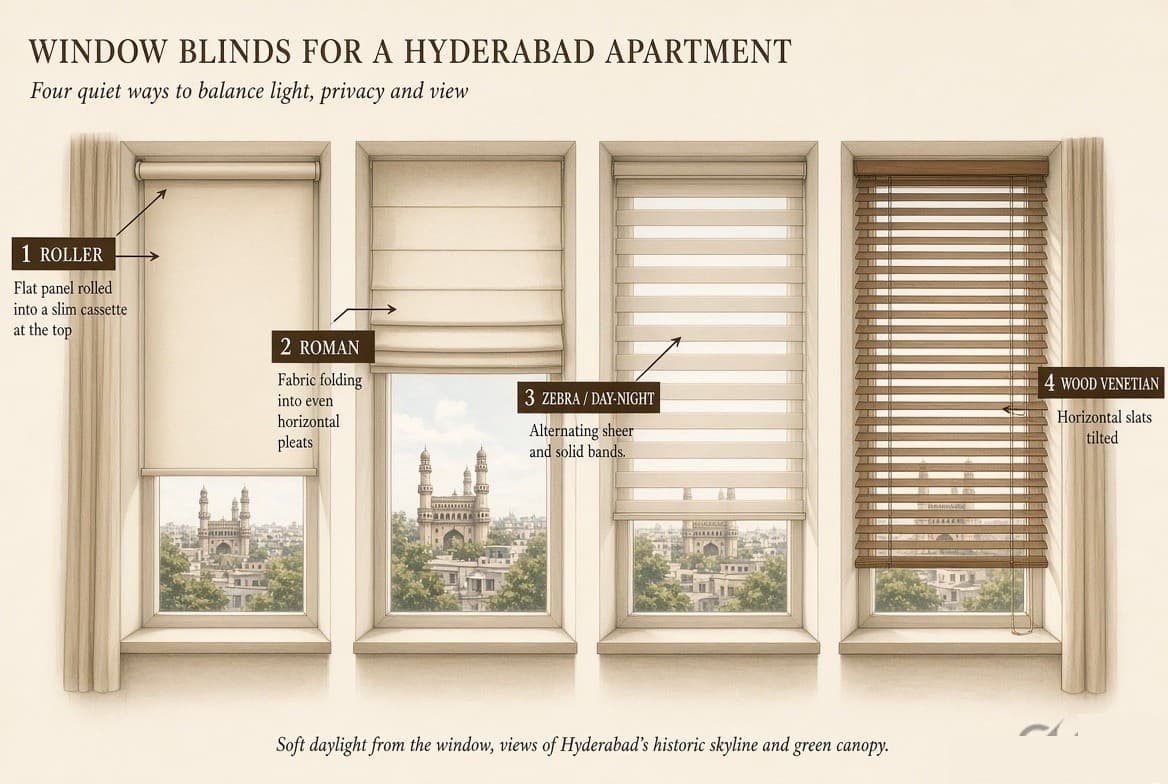
Roller
One flat panel that rolls up. The least fuss, the least cost. Best for small windows, kitchens, study rooms, and any opening where you want the glass back the moment the blind is up. Screen fabric keeps a view and knocks the glare down. Blackout fabric sleeps a room — if the edges are dealt with.
A PVC or coated roller is the kitchen answer. Fabric near a hob holds smell and stains, and no amount of cleaning fixes it.
Roman
Folds in soft horizontal pleats. Reads as fabric rather than as hardware. This is the blind we put in a room that still wants cloth on the window but has no wall to stack a 3.0-fullness pair into.
A Roman is made, not bought off a roll: face cloth, lining, rods in the pockets, a clean headrail. Pattern works here in a way it does not on a sixteen-foot slider — the child’s map-room Roman at My Home Vihanga is the example. Lined, it can dim. Behind dress curtains, it can black out.
Zebra, or day-night
Alternating sheer and solid bands that slide over each other, so you tune the light without fully closing. Line the sheer bands up and you get filtered light with no clear view in. Slide them and you get the window back. Best for living rooms and home offices that face a road or a neighbour.
A zebra is not a blackout. People buy it hoping it will be both, and then they sleep in stripes. If the room has to go dark, specify a blackout roller with channels, or a lined Roman, or curtains.
Venetian — wood or faux wood
Warmer than metal, and it adjusts to the angle of the sun. Real wood in studies and living rooms; faux wood in kitchens and bathrooms, because real wood swells. Slats let you throw light at the ceiling and keep the view below.
Dust lives on every slat. If nobody in the house will wipe them, this is the wrong blind.
Blackout roller with side channels
Channels down both edges stop the light leak roller blinds normally have at the sides. Best for nurseries, shift workers and home theatres.
The cloth can be perfect and the room will still glow at the edges if the blind is fitted inside the reveal without channels. Side channels close the gap. Fitting outside the reveal, wider than the opening, is the other fix.
Cellular, or honeycomb
Cells that trap a layer of air, so the blind insulates as well as shades. Available blacked out. Best for west-facing glass and bedrooms that run hot.
It will not replace a decent AC. It will take the blast off the glass the way a lined curtain does, in a window that cannot take a curtain.
Printed, and motorised
A print stays sharpest on a roller — offices, studios, one wall that has to say something.
Motorised blinds run on a remote or an app, wired or battery. Best for high windows, stairwells, anything you cannot reach. Battery tubular motors need no new wiring, which matters if the room is already finished. A wired motor wants a point at the head before the gypsum closes.
Curtain, blind, or both
| Choose | When | Do not |
|---|---|---|
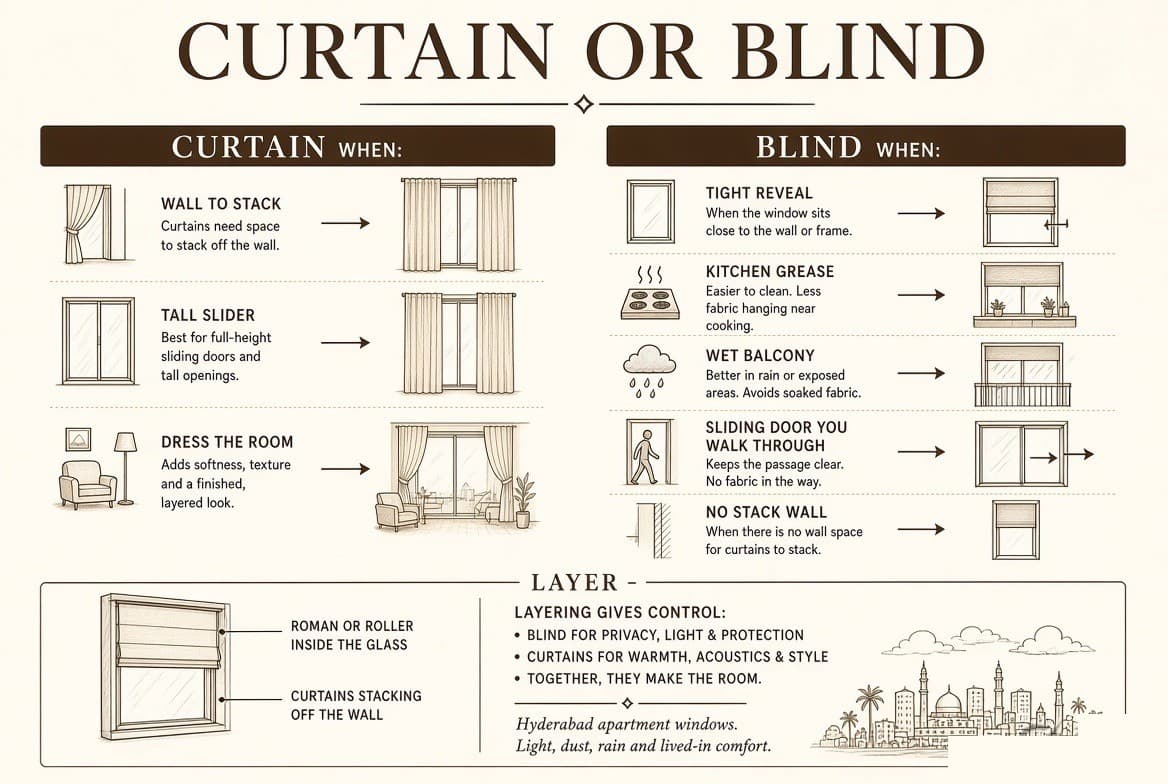
| Curtain | Wall to stack into; a tall slider; the room wants dressing | A tight reveal; a wet balcony; above a hob; a slider you walk through |
| Roller | Small window; kitchen; study; pulls clear of a door | As the only treatment in a formal living room |
| Roman | A bedroom or living window that wants fabric without the stack | Above a hob; on a wet balcony |
| Zebra | Daylight and privacy facing a road or a neighbour | As blackout for a light sleeper |
| Venetian | Tuning the sun in a study; faux wood in wet rooms | If nobody will dust the slats |
| Channelled blackout roller | Nursery, shift sleep, home theatre | Fitted inside the reveal with no channels and called blackout |
| Layered | A tight bedroom window; living glass you still want to dress | Two systems fighting each other for the same job |
The sentence we use most: a Roman or a roller inside the reveal, with curtains stacking off the glass, is usually the cleanest answer in a bedroom with a tight window and no wall to park fabric.
Inside the reveal, outside, and the leak at the edge
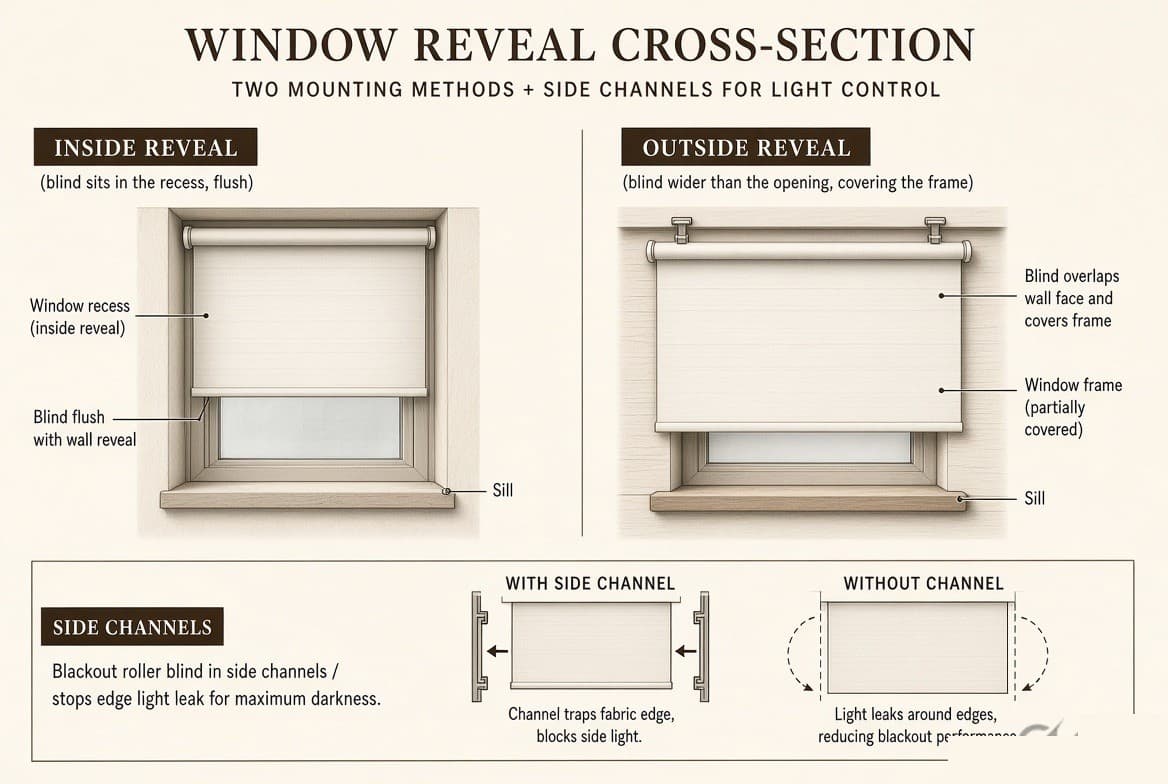
Inside the reveal: the cassette sits in the recess, flush. The window looks finished. You lose a little glass. The reveal has to be deep enough and square enough, and builder frames in this city often are not.
Outside the reveal: the cassette sits on the wall, wider and taller than the opening. More light stopped at the edges. The frame disappears. Use this when the reveal is shallow, out of square, or when blackout actually matters.
A blackout roller without channels, fitted inside, is why people say blackout "doesn’t work". The cloth is not the failure. The gap is.
Room by room
- Kitchen, above a hob. PVC or coated roller. Fabric holds oil. Faux-wood Venetian if you want slats.
- Bathroom. Faux-wood Venetian or a coated roller. Real wood swells.
- Study or home office. Zebra, or a wood Venetian. Tune the glare on the screen.
- Nursery or shift-sleeper. Blackout roller with side channels. Daytime naps are a harder light problem than night.
- West glass that cooks the room. Cellular or honeycomb, blacked out if somebody sleeps through the afternoon.
- Tight bedroom window. Roman inside the reveal, dress curtains off the glass if there is wall for them.
- Balcony slider you walk through. A wide roller or a zebra. A curtain in front of a sliding door gets caught in it.
- Stairwell or high glass. A motor. Battery, if the ceiling is already closed.
Hotels and resorts here — Lore is the example — run rollers through wet and service rooms and layer curtains where the guest is meant to stay. A resort textile that cannot be wiped is a textile that will be replaced.
Child safety
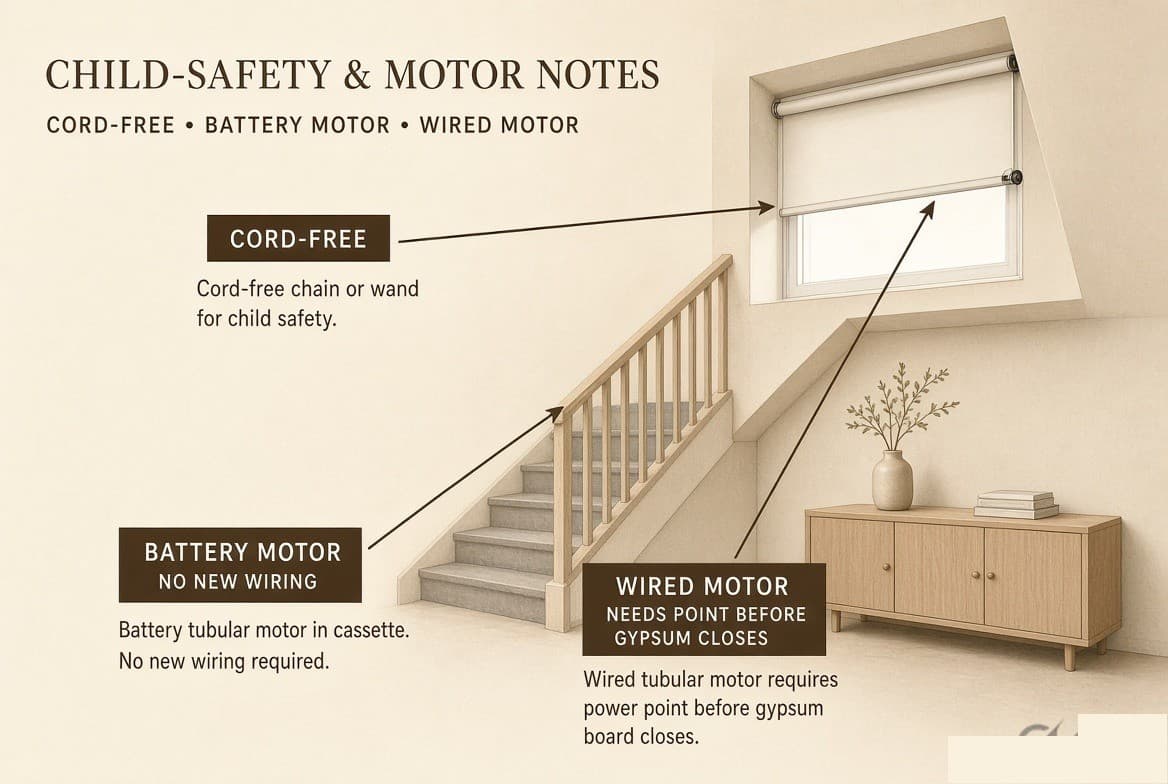
In a child’s room the hardware comes first. Loop cords are the hazard: a nursery or a toddler’s room gets a cord-free chain, a wand, or a motor.
Mounting height matters. Durable cloth matters less than whether a two-year-old can pull a loop tight. Safety decides the hardware; the fabric follows. The whole of a child’s room is worked through here.
Maintenance
- Roller, screen, PVC. Wipe with a damp cloth. PVC and coated cloth take a kitchen.
- Roman. Vacuum with an upholstery head, spot-clean the face. Do not machine-wash a made Roman.
- Zebra. Vacuum. The sheer bands show dust first on a road-facing window.
- Venetian. Dust every slat, or do not buy them.
- Cellular. Vacuum. Do not crush the cells.
Hyderabad dust sits on everything. A pale roller facing a road will look tired in a year if nobody wipes it. That is not a fabric failure.
What quality work costs
These are 2026 bands for a finished blind, installed — cassette or headrail, decent cloth, and a proper fit — before GST.
| Type | Quality band, installed | Notes |
|---|---|---|
| Roller — screen or dimout | ₹280–550 / sq ft | Cassette, decent cloth, chain |
| Zebra / day-night | ₹350–650 / sq ft | Not a blackout |
| Blackout roller with side channels | ₹420–700 / sq ft | The channels are the cost that matters |
| Cellular / honeycomb | ₹450–800 / sq ft | Blacked-out cells at the top of the band |
| Roman, lined, made to measure | ₹480–900 / sq ft | Face, lining and rods. The cloth grade moves this |
| Wood Venetian | ₹500–900 / sq ft | Real wood. Faux sits lower |
| Battery tubular motor, added | ₹8,000–18,000 / window | No new wiring |
| Wired motor, added | ₹18,000–30,000 / window | Needs a point at the head before the gypsum closes |
A cheap PVC roller at ₹70–120 / sq ft exists, and a quote at a third of these bands is quoting one. It is not what we hang in a bedroom we have also dressed.
Always confirm against the current book. The manufacturer’s warranty on the blind and the motor passes through; our own fitting is guaranteed for three months.
Limitations
- A roller never dresses a room the way a 3.0-fullness pair does. That is not a flaw, it is the point.
- A zebra will not sleep a light sleeper’s room.
- A Roman over a hob will smell of last night’s tadka by August.
- An inside-reveal blackout without channels leaks. Always.
- A wide slider still wants the cloth to pull fully clear of the walk-line. If the cassette cannot, split the run.
- We do not revive blinds that have been up for years. Recent work of ours that has come loose is a different conversation, and the FAQ says where you stand.
- We do not make blinds from cloth you bring in. Controlling the cloth from the start is the only way the finished blind hangs and wears as quoted.
When to order
Decide curtain, blind or both before the false ceiling closes. The pocket and the pelmet are ceiling decisions; a wired motor is an electrical decision; a battery motor can wait.
Measure the finished opening, after paint and flooring if you can stand it, because builder frames move. An inch off the drawing is a remake.
Typically 7 to 14 working days after signed sizes, depending on the cloth and on whether the Roman is being made here. Most flats take a morning to fit; a villa of sliders takes a day, and stairwell motors take the ladder rather than the clock. The date on your quote is the one to hold us to. Order blinds in the same phase as the curtains: after the ceiling line is known, and before you live with builder roller-blinds that do not fit the opening they were cut for.
Buying — do, and don’t
Do.
- Ask inside or outside the reveal, and whether "blackout" includes the channels.
- Ask what the quote is per square foot of finished blind, installed — not per metre of cloth.
- For a child’s room, ask cord-free before you ask colour.
Don’t.
- Buy a zebra for a room that has to go dark.
- Order off the drawing.
Installing — do, and don’t
Do.
- Check the reveal is square before committing to an inside mount.
- On a slider, make sure the cloth clears the walk-line when raised.
- If there is a dress curtain as well, set both so they do not fight for the same 40 mm of frame.
Don’t.
- Screw a headrail into gypsum and call it a ceiling fix — at any weight. Board holds nothing; the fixing goes into the slab or into a noggin.
- Start a wired motor after the ceiling is painted.
What to send us
A photograph of the window from the room, one of the reveal depth, and one of the ceiling line. Kitchen, bathroom, nursery, slider, stair — say which. And whether anyone has to sleep through Hyderabad daylight in that room.
That is enough to say roller, Roman, zebra or layer.
Come and see the samples. We measure the window rather than the drawing; blinds are supplied and fitted by us, and Romans that take our cloth are made with it. The showroom is House No 536, First Floor, Road No. 12, NBT Nagar, Banjara Hills, Monday to Saturday, 11am to 8.30pm. A site visit is ₹500 and it comes off the bill if you go ahead.
Blinds are here if you want the short version, and the curtain side of the same decision is here.
Still stuck? Send a photograph of the window on WhatsApp and we’ll tell you what will and won’t work. Or read more about blinds.
This is the point where a measurement usually matters more than a preference. If you’d like us to look at it properly, start here.
Send a photo of the window — it usually tells us more than a description.
We have done this one
Lore Resorts and Conventions, Maheshwaram & Shadnagar
Fifty rooms, and a reception with nowhere to hide the track. Resort, 50 guest rooms — written up in full, including what we had to sort out.
Read next
- Small apartment living room curtains & blinds
Track calculations and low stack-back for living rooms under 12×14 ft, so an open curtain stops eating the wall the room cannot spare.
- Curtain fabrics in Hyderabad
What the cloth is made of, when blackout earns its cost, how 3.0 fullness is calculated, and which heading belongs on which Hyderabad window.
- Curtain tracks, pelmets and motors in Hyderabad
Pelmet box, false-ceiling pocket or a rod meant to be seen — the hardware above the curtain decides whether the room reads finished.
- A kids’ bedroom in Hyderabad — safety first, then sleep
Cord-free window hardware, blackout that survives a daytime nap, a sleep surface that can be washed, furniture that stays up, and one wall that gets to play.
NBT Nagar, Banjara Hills, Hyderabad 500034+91 96769 21216