
Headboards — the designs, the build, and the one you already own
Aakriti Nagpal · 10 September 2026 · 18 min read
What a headboard is actually doing, how an upholstered one is made, the six shapes Indian homes keep asking for, and whether yours is worth recovering.
A bed without a headboard still works. People sleep on it every night. What it does not do is finish the room.
Pillows slide down the wall. The plaster behind them picks up hair oil and the faint grey of a monsoon. Sitting up to read means leaning on a painted surface that was never meant for a shoulder. And the wall looks unfinished from the door, even when the rest of the room is done.
A headboard solves those four problems at once. It is a backrest, a wall protector, a visual stop for the pillows, and the one surface in a bedroom large enough to carry a fabric or a timber without looking like decoration stuck on afterwards.
In Hyderabad flats — ten- and eleven-foot ceilings, builder sockets in odd places, beds that get shifted every two years — the useful question is not which board it came off. It is how it is built, how it is fixed, and whether the one you already own is worth keeping.
What a headboard is actually doing
Most people buy one because the bedroom looks incomplete. That is fair. The useful work is more specific.
- Back support. When you sit up to read, take a call, or feed a child, your back needs a padded stop. A timber slat will do it. Upholstery does it without bruising a shoulder.
- The wall. Hair oil, sweat and the back of a pillow leave a mark on emulsion within a season. Fabric or timber sits between the sleeper and the plaster.
- Scale. A queen or king mattress is a large, low rectangle. Without something taller behind it the wall reads as leftover space. The headboard is what the eye lands on from the door.
- Sound. In a tiled bedroom the sound bounces. A padded panel the width of the bed takes a surprising amount of that off.
- A place for the scheme to start. Once the headboard is decided, the linen, the curtains and the side tables have something to agree with. Rooms that feel finished usually started here, not with a painting.
It is also the piece guests lean against when they sit on the edge of the bed to talk. Hotel rooms understood this decades ago, which is why the current fashion in Indian apartments — wide, padded, often wall-to-wall — is less a trend than a catching-up.
How an upholstered headboard is made
The finished face is cloth. Underneath it is a sandwich, and the sandwich decides whether the piece still looks taut in three years or has gone baggy at the corners.
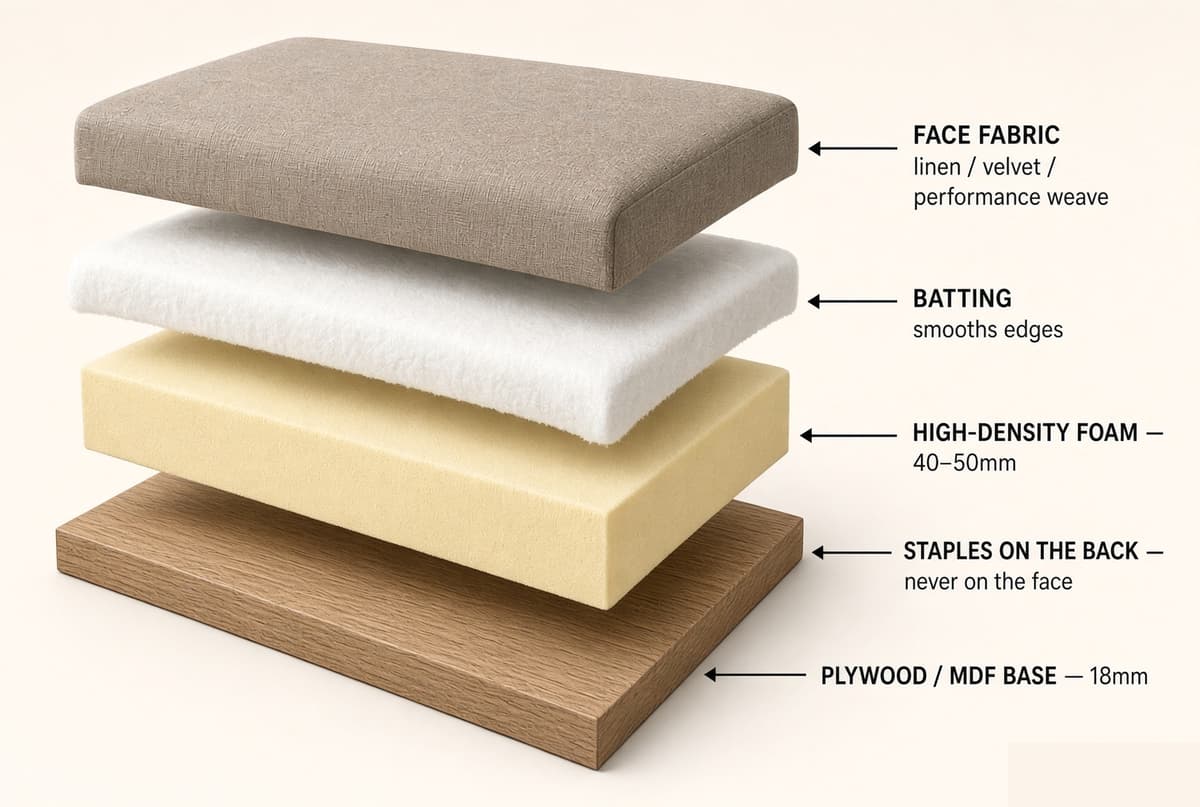
The board. Eighteen-millimetre plywood or a dense MDF. Plywood takes staples more kindly and is the better choice if the piece will ever be recovered again. MDF cuts a cleaner edge for a shaped silhouette — an arch, a wing, a scallop — but it is heavier and less forgiving if a fitter has to drill through it on site.
The board is cut to the finished width and height before anything soft goes on. For a Hyderabad queen — typically 60 to 66 inches, 5 to 5.5 ft — that is the mattress width plus a little either side, not less. A king, 72 inches in the Indian size, follows the same rule. Going narrower than the mattress is the one proportion that always looks accidental.
The foam. High-density upholstery foam, 40 to 50 mm for a standard padded face, thicker where the design is channel-tufted or buttoned and the foam has to take a fold. Soft mattress foam collapses. The density is what keeps a channel looking like a channel after a year of people sitting against it. Spray adhesive holds it to the board so it does not creep while the batting goes on.
The batting. A layer of polyester wadding wrapped over the foam and pulled to the back. It hides the square cut of the foam, rounds the edge, and stops the face fabric from reading every staple and every joint. Skip it and the corners look cheap even in a good cloth.
The face fabric. Pulled taut from the centre of each side, stapled on the reverse, corners folded the way an upholsterer folds a parcel rather than bunched. Patterned cloth has to be centred before the first staple goes in; a stripe that drifts is visible from the door.
We work only with fabric we have supplied, for the same reason we do on curtains: once the cloth is on, you cannot argue with how it hangs, how it pills, or how it takes a monsoon.
What sits on top of that sandwich is optional — vertical channels, deep buttons, a double welt around the edge, nailhead, a timber frame, a cane insert. Those are finishes. They do not change the four layers. They do change how much time the workshop spends on the piece, and how the piece ages. Channels hide a small stain better than a flat face. Buttons catch dust. Velvet marks. Performance weaves and a tight linen do not.
A note on "tufted". Button tufting and channel tufting are not the same job. Buttons pull the cloth into a grid of dimples and need a foam thick enough to take the pull. Channels are sewn or stapled as vertical — sometimes horizontal — pads. In Hyderabad master bedrooms the channel is currently the more common request: it reads as a hotel suite without the maintenance of a hundred buttons.
The six shapes that keep coming back
Taste in this country is not one taste. A villa in Mokila and a 3 BHK in Gachibowli will not ask for the same thing. Across the work we see, six shapes keep returning.
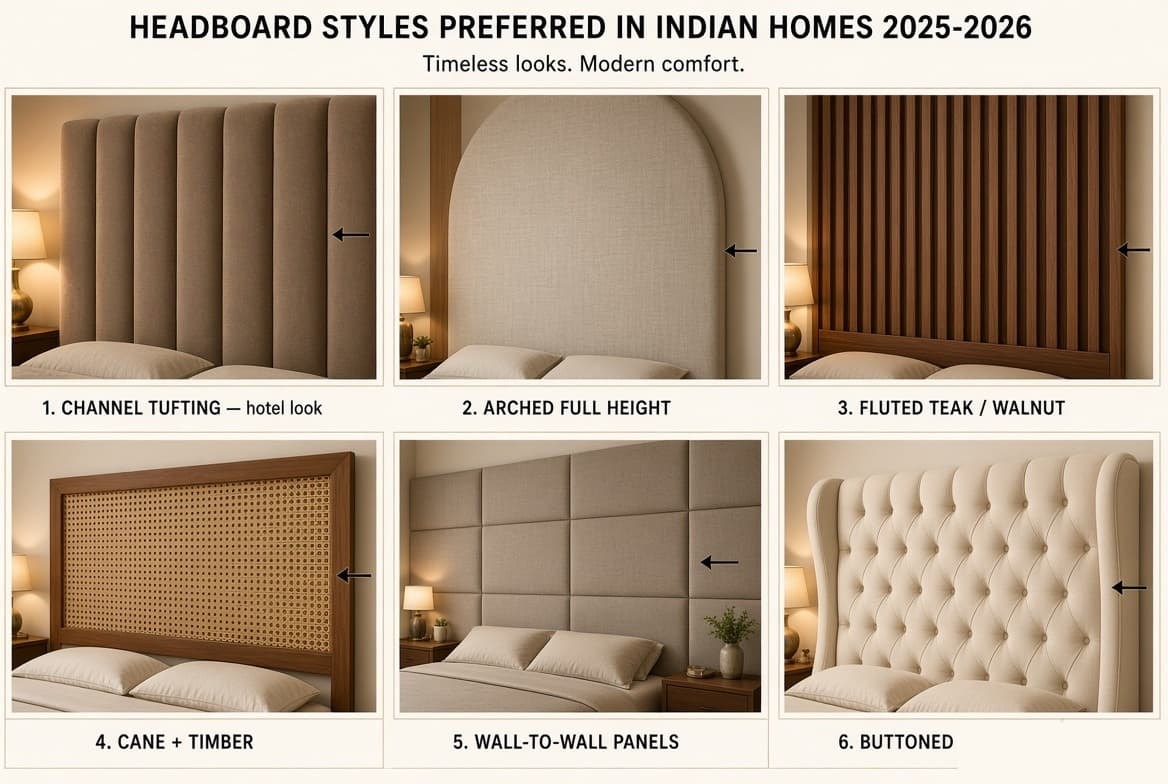
1. Vertical channel tufting. The default luxury look of the last two years. Soft, structured, works in taupe, sand, ivory and mocha. It photographs well and it sits well. Best in a cloth with a little body — a performance linen, a tight velvet, a wool blend. Weak in a thin cotton that will show every pull.
2. The arched, often full-height, upholstered panel. The fastest way to make a rectangular builder bedroom feel designed. The arch takes the curse off a nine- or ten-foot box, and it wants height. In a room with an eight-foot slab and a fan in the middle of the wall it is the wrong shape. Measure the fan and the AC indoor unit before anyone draws the curve.
3. Fluted teak, walnut or a good veneer. Vertical timber slats, sometimes with a slim upholstered insert, often with a warm LED wash from above or behind. This is the piece people choose when they do not want fabric on a wall that will see children, or when the rest of the room is already heavy with cloth. It is also the one that survives a wet cloth. Dust collects in the grooves; that is the maintenance, not a fault in the timber.
4. Cane and rattan in a timber frame. An old Indian material that has come back without the 1980s furniture it used to sit on. Light, breathable, right for a warm city. Pair it with linen bedding rather than a shiny satin. The cane is the decoration; it does not want a busy wallpaper behind it.
5. Wall-to-wall padded panels. Not a headboard in the old sense — the whole bed wall is upholstered, sometimes with the side tables built into the same run. The bed stops looking like a piece of furniture parked against a wall. It needs a wall without a window, and it needs the sockets planned before the panels go on. Doing this after the electrician has left is how you end up cutting a hole in a finished face.
6. Buttoned wingback. The traditional upholstered silhouette. Wings give a sense of being enclosed, which some people want and some find heavy in a small room. Deep buttons are a commitment to a look, and to dusting. We still make them. We say so before the order is placed.
Colour. What holds in Hyderabad light: warm ivory, sand, taupe, a dusty olive, a rust that does not fight the teak. Cold grey dies in our afternoon sun. A strong jewel colour works as a single padded panel in a room that is otherwise quiet. It does not work as wall-to-wall.
What we see less of, except in older independent houses, is ornate carved rosewood as the only surface. Families keep those frames. They do not always keep the carving on show. Recovering the centre panel in cloth and leaving the timber as a frame is the usual compromise — which is the section after next.
Two ways it goes on: the wall, or the bed you already own
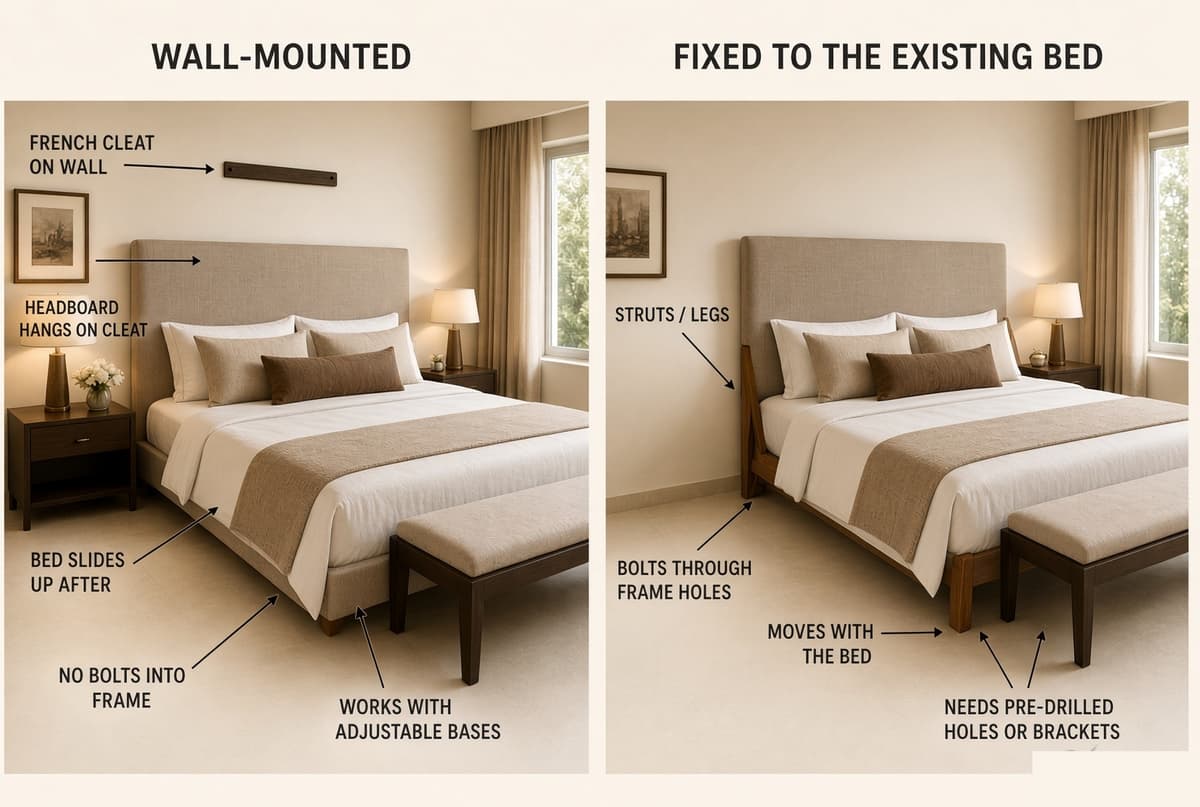
This decision matters more than the fabric. A headboard bolted to a bed moves when the bed moves. A headboard hung on the wall stays put when you change the mattress, add an adjustable base, or pull the frame out to sweep.
Both are correct. They are not interchangeable.
How it is done on the wall
Most of the better work in this city is now wall-hung. New flats have masonry or RCC walls that will take a proper fixing.
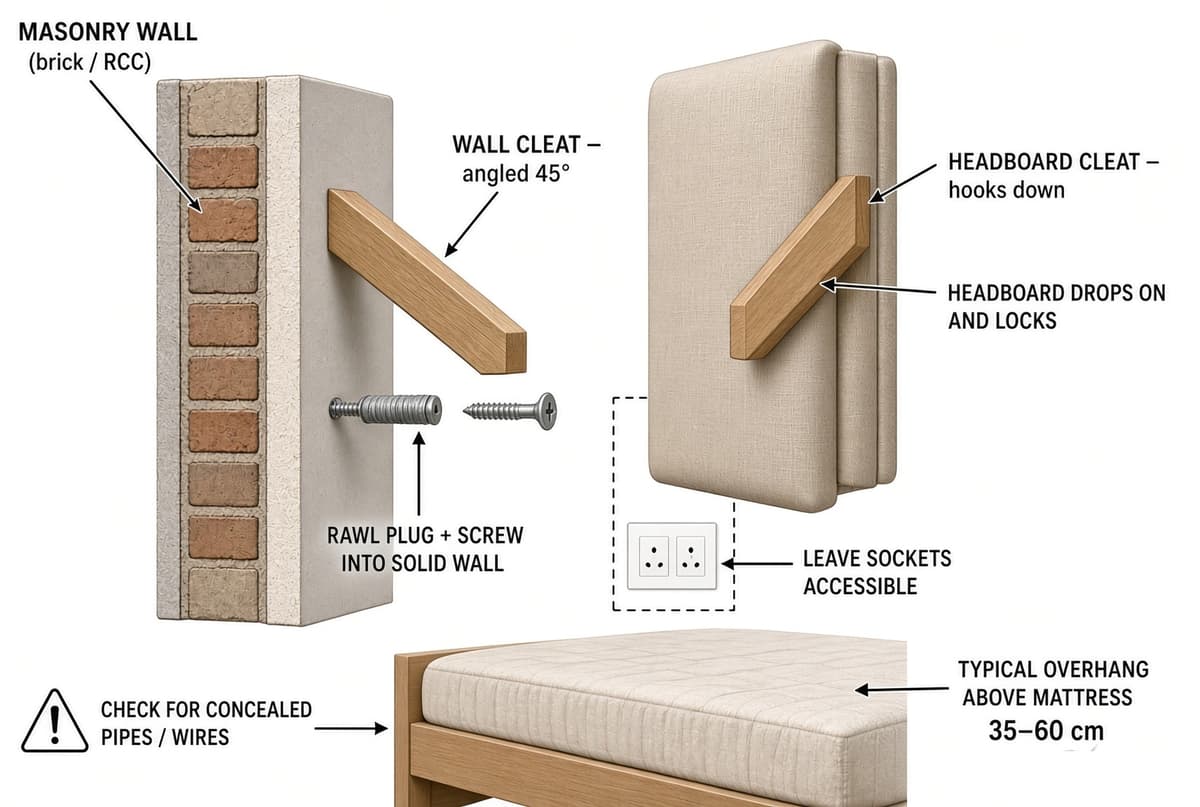
The clean method is a French cleat: two timber or aluminium battens cut at 45 degrees. One is screwed to the wall, the matching one to the back of the headboard. The piece drops on and locks. Two people lift it, and one person can take it off again if the wall ever needs paint.
The sequence on site is short, and the mistakes are always in the measuring rather than the screws.
- Width of the mattress. Width of the wall. Position of the sockets, the AC, the fan, any window reveal. A photograph of the wall with a tape held against it tells us more than a floor plan.
- How much of the headboard should show above the pillows. In a standard Hyderabad room that is usually 35 to 60 cm of face above the mattress. Taller than that needs a taller ceiling, or the piece starts to crowd the fan.
- Fixings go into solid masonry with a rawl plug, or into a noggin. Never into gypsum: board is a lining, it holds nothing, and a cleat carrying a 40-kilo panel levers the load straight out of it. If the bed wall is a drywall box-out, say so before the workshop builds one.
- Pipes and concealed conduit run in these walls. We mark, we check, and we do not drill a neat row of holes through a cold-water line.
- Sockets that serve the bedside lamps have to stay reachable. A wall-to-wall panel that covers them is a panel that will be cut on site, and the cut will show.
Once the cleat is level and the headboard is on, the bed comes back to the wall. There should be no visible gap and no need to bolt the frame to the panel. That independence is the point: change the mattress next year and the headboard does not care.
Adjustable bases. If the base articulates, the headboard must not be bolted to it. Wall-mounting is the only method that stays tidy when the head of the mattress lifts. Bolting a padded panel to a moving frame opens a gap and loosens the fixings within a month.
How it is done on the existing bed
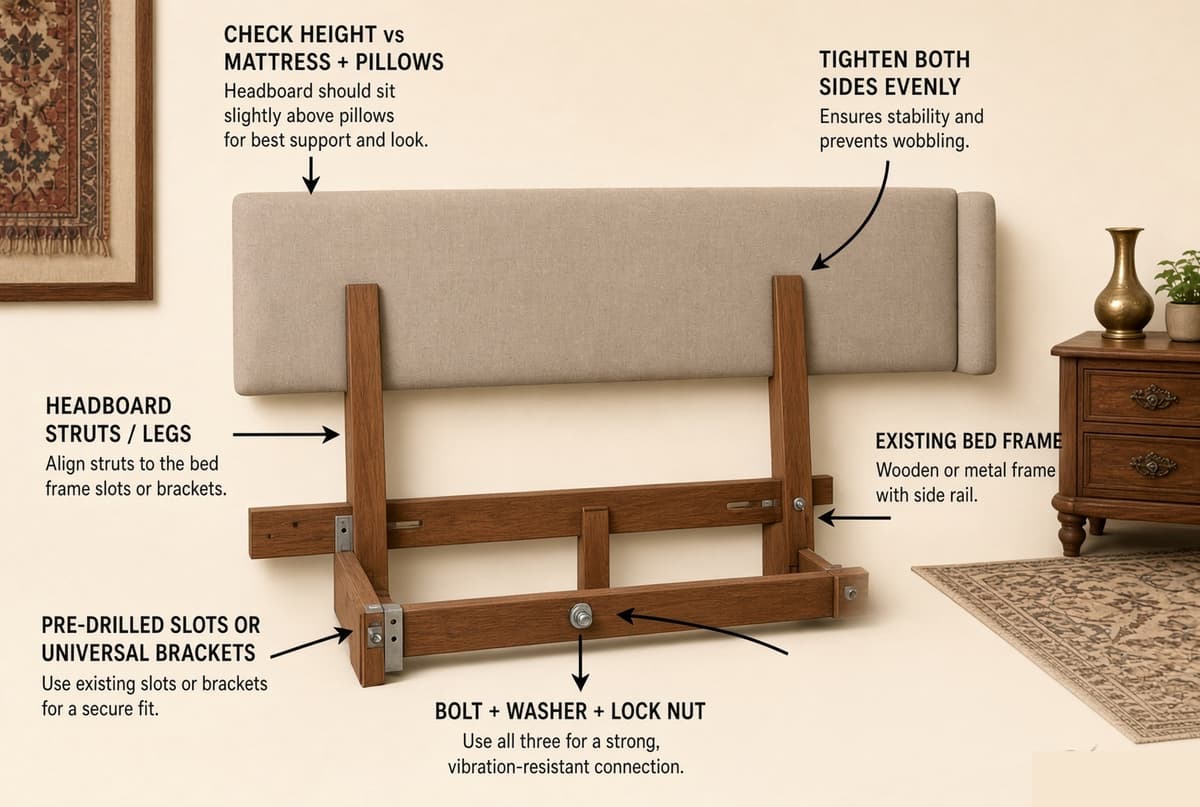
Plenty of Hyderabad bedrooms already have a decent wooden or metal frame — a storage cot, a hydraulic-lift king, a sheesham bed bought ten years ago. The frame can stay. The headboard can still change.
Three situations, in the order we meet them.
- The frame is ready. It has slots or pre-drilled holes at the head. The new headboard is built with matching struts. Bolts go through, washers stop the timber crushing, and lock nuts stop the wobble that starts after the first monsoon of somebody sitting up against it.
- The frame has no holes. A pair of universal brackets or adapter plates create the missing ones. This is the usual workaround on a metal box frame or a platform bed sold without a headboard in mind.
- The frame will not take one. Some hydraulic storage beds, and most fully upholstered box beds, have nothing useful to bolt to. Forcing a strut onto them is how you crack a panel. Wall-mounting is the honest answer.
Height still has to be set against the mattress you actually own, not the one in the brochure. Indian mattresses run from a slim four-inch foam to an eight- or ten-inch pocket spring. A headboard set for the slimmer one will look short when the mattress is upgraded, so we measure with the current mattress on the frame and leave a little extra face above the pillows.
A bed-mounted headboard also moves when you pull the bed out to sweep. That is convenient in a room cleaned that way, and inconvenient if the wall behind it is freshly painted and the headboard is not quite the same width as the mark it leaves.
If you already have an old headboard
This is most of the work, not the exception.
Families in Banjara Hills, Jubilee Hills, Begumpet and the newer west-side societies are not starting from an empty room. They have a bed. It has a headboard. The headboard is the wrong colour, the foam has gone flat, the carving is from a different decade, or the fabric has taken the room’s last ten years of hair oil.
Throwing the whole bed out to fix the wall behind it is an expensive way to change a cloth. The question is whether the frame is sound.
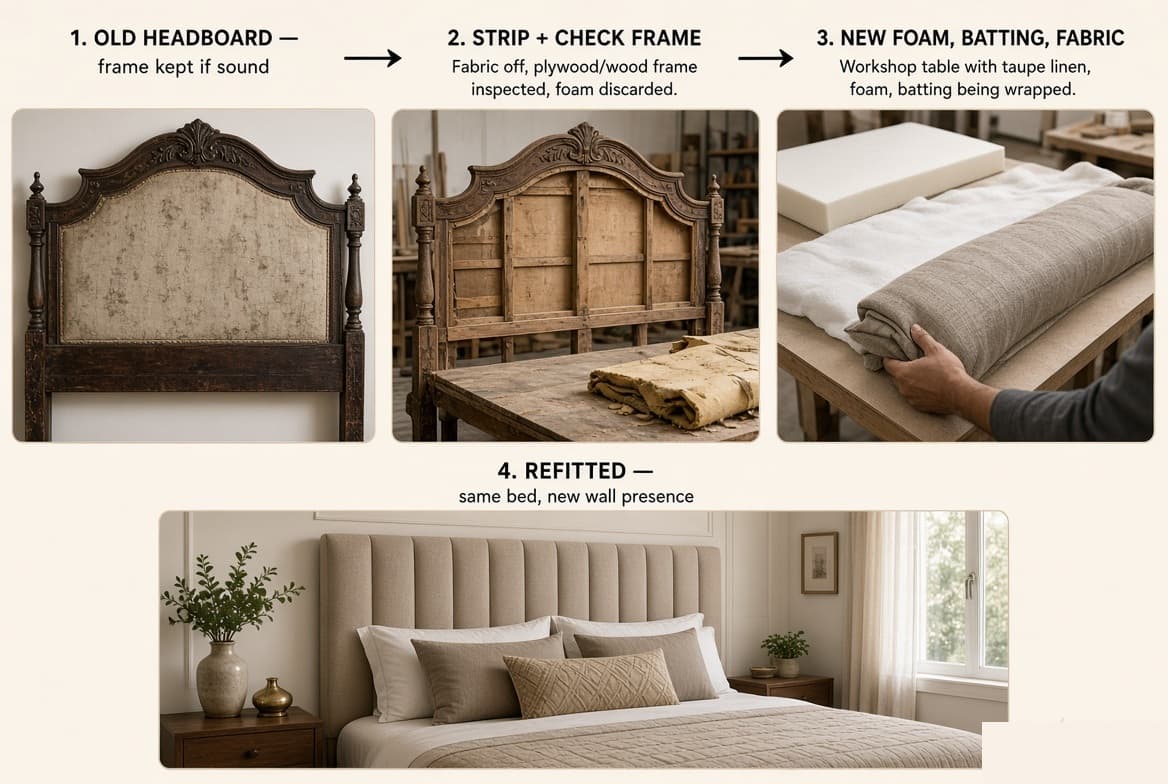
The rule is the same as it is on a sofa: if the structure is honest, we do not replace it for the sake of a catalogue photograph.
- We look at the thing. A photograph first, then a site visit. We look at the joints, the back of the panel, whether the legs are split, whether the board is a particle that has already swollen. The visit is ₹500 and it comes off the bill if the job goes ahead.
- We strip it. Old fabric and collapsed foam come off. The timber or plywood is cleaned, re-glued where a joint has opened, and checked for woodworm in older independent-house pieces.
- We rebuild the soft layers. New high-density foam, new batting, new face fabric from the same books we use for curtains and sofas — so the bedroom can agree with itself. Channels, a plain taut face, a welted edge or a buttoned grid: chosen against the room, not against a trend list.
- Or we keep the timber and change the panel. A carved rosewood or teak frame with a tired centre panel is often the best candidate. The carving stays; the centre is padded and covered. You keep the piece that belonged to the house and lose the fabric that did not.
- If the old piece is not worth saving. Too narrow, too short, or made of a board that will not take a staple — then we build a new face and either hang it on the wall in place of the old one, or build a new strut-mounted piece for the existing frame.
- We fit it. The people who measured it are the people who bring it back and hang it. That is the only way a wall fixing ends up level with the sockets it was planned around.
What we will not do. We do not recover a headboard in a fabric we did not supply — colour, rub count and how the cloth takes a staple are not things anyone can judge off a roll that arrived from somewhere else. And we will not hang a panel on a gypsum partition — not with rawl plugs, not with cavity anchors, not at a lighter weight. If the wall is board, the answer is a noggin behind it, or a bed-mounted piece, not a hopeful drill.
Sizing that survives a Hyderabad bedroom
Indian bed sizes are not US sizes. Quote the mattress you own, in inches, not the name on the tag.
| Mattress (India) | Typical width | Headboard width | Height from floor, usual rooms |
|---|---|---|---|
| Single | 36 in / 3 ft | 36–40 in | 100–120 cm |
| Queen | 60–66 in / 5–5.5 ft | mattress + 0–4 in | 120–150 cm |
| King (Indian) | 72 in / 6 ft | mattress + 0–6 in | 130–160 cm |
| Wall-to-wall panel | the wall | wall minus the reveals | 150 cm to full height |
Ceiling height decides the upper limit. A nine-foot room with a fan and an AC indoor unit on the bed wall will not take a floor-to-ceiling arch, however much the reference image liked it. A villa with eleven or twelve feet can. We measure the obstacles on the wall before we cut the board. Taste comes after that.
Fabric that belongs in this climate
Hyderabad is dust, a long summer, and air-conditioning that runs for months. The cloth on a headboard is touched every day and almost never washed. Choose for that, not for the sample in noon showroom light.
- What works. Tight weaves, performance linens, and a good velvet if the room is treated as a suite rather than a children’s crash-pad.
- What to test against. Hair oil, and a wet cloth. Try a sample with both before you commit a whole wall.
- What shows. A pale flat cloth shows every head-shaped mark. A channel, or a mid-tone, hides it.
- What to match. Match the curtain cloth only if you want the room to read as one scheme. A contrast in the same family of colour is usually calmer. The fabric guide covers the faces themselves.
Leatherette has a place on a guest-room piece that needs to be wiped. It has a smaller place in a master bedroom that is trying not to feel like a clinic.
What to send us
A photograph of the bed and the wall behind it, taken from the door. A second photograph of the existing headboard from the side, so we can see the depth and the legs. The mattress size in inches. Whether you intend to keep the current frame. And if the wall has sockets, a fan or an AC on it, include those in the frame.
That is enough to say whether we recover, rebuild, or start a new panel, and whether it should hang on the wall or bolt to the bed.
Fabric is the part that still needs a hand on it — colour and weight both photograph badly — so the showroom visit, or a sample sent to the house, comes after.
Come and see the cloth. We make the upholstery ourselves, and headboards sit in the same workshop as the sofas we recover and the cushions we make to match a curtain, which is the point of doing this in one place. The showroom is House No 536, First Floor, Road No. 12, NBT Nagar, Banjara Hills, Monday to Saturday, 11am to 8.30pm. A site visit is ₹500 and it comes off the bill if you go ahead.
Upholstery is here if you want the short version, and the bedroom curtains that will end up agreeing with it are here.
Still stuck? Send a photograph of the window on WhatsApp and we’ll tell you what will and won’t work. Or read more about upholstery.
This is the point where a measurement usually matters more than a preference. If you’d like us to look at it properly, start here.
Send a photo of the window — it usually tells us more than a description.
Read next
- Bedroom curtains in Hyderabad
Blackout for the tower opposite rather than the sunrise, a lining that helps the AC, and a drop that meets the floor. How we hang a bedroom curtain here.
- Master bedroom blackout system for deep sleepers
The measurements that make a master bedroom genuinely dark — side coverage, centre overlap and hem clearance, not just a fabric labelled blackout.
- Curtain fabrics in Hyderabad
What the cloth is made of, when blackout earns its cost, how 3.0 fullness is calculated, and which heading belongs on which Hyderabad window.
NBT Nagar, Banjara Hills, Hyderabad 500034+91 96769 21216