
Memory foam vs latex vs spring — which mattress for a Hyderabad bedroom
Aakriti Nagpal · 30 August 2026 · 13 min read
Four constructions, what each one does in eight hot months and a humid monsoon, and the two questions to settle before firmness.
Heat is the local variable. Firmness is the one everybody argues about in the showroom. Get those two in the right order and the rest of the decision gets simpler.
Most of what is sold in this city falls into four constructions: memory foam, natural latex, pocket spring and Bonnell spring. They feel different, they age differently, and they behave differently in eight hot months and a humid monsoon. This is the comparison we walk people through on the floor in Banjara Hills.
If you already know the type and want the shopping checklist — how long to lie down, what to put on the bill, how to measure a carpenter-made frame — read how to buy a mattress in Hyderabad first.
What is actually inside the four constructions
Memory foam is viscoelastic polyurethane. It softens with heat and weight, then recovers slowly. That is the "hug". It isolates motion well, which couples like. It is also a dense block. In an air-conditioned bedroom that density is a non-issue. In a fan-only room in May it is the difference between sleeping and not.
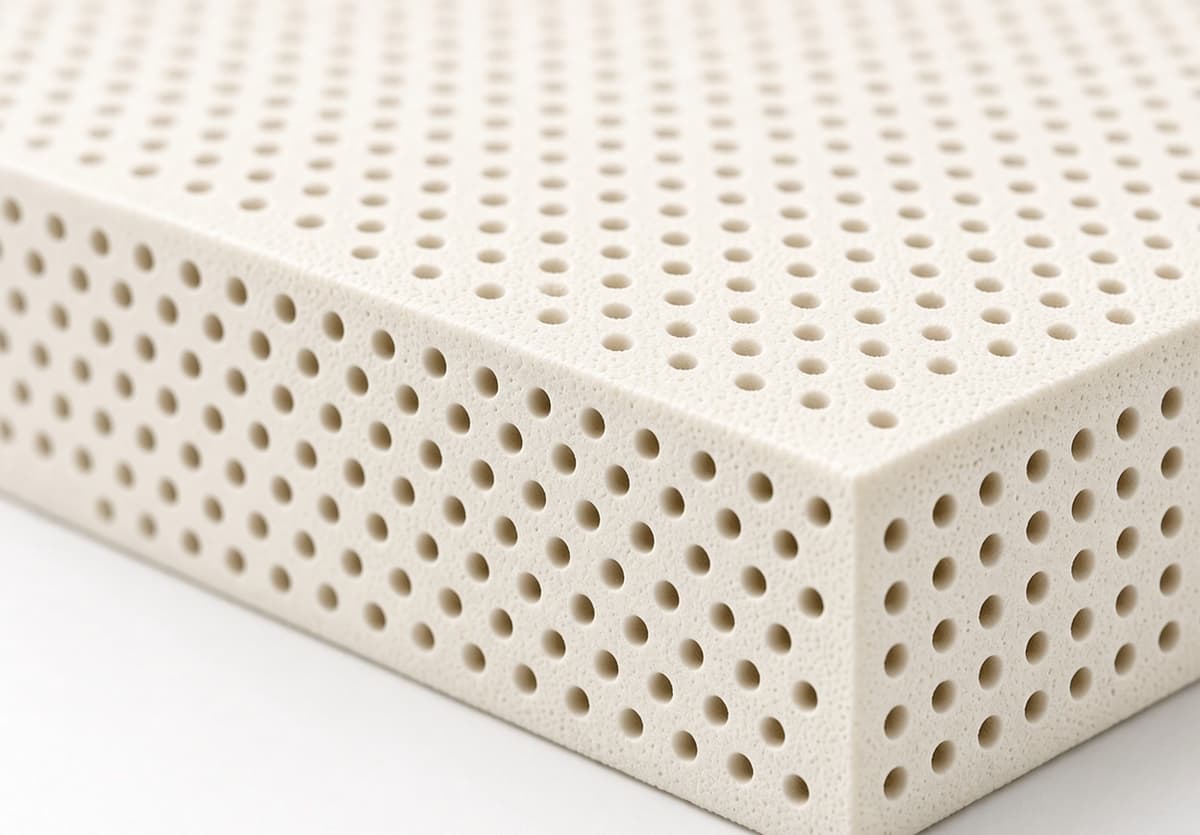
Natural latex is rubber-tree sap, whipped and moulded into foam. Good latex rebounds quickly rather than sinking. Air can move through the open cells — and, on a pincore mattress, through thousands of pin-sized holes moulded into the block. It is heavier than foam, more expensive at the till, and usually the one still holding its shape a decade later.
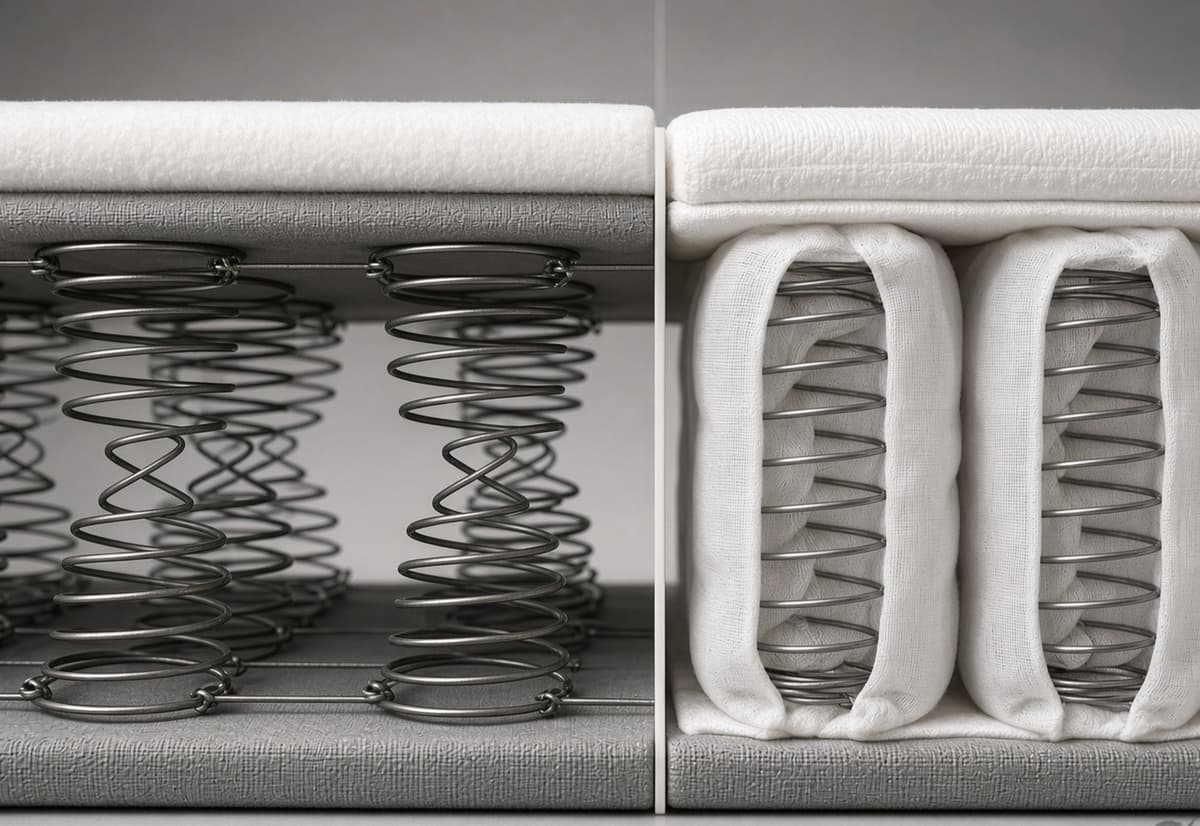
Bonnell spring is the old interconnected coil unit: hourglass springs wired together so they move as one sheet. Bounce, airflow, a lower price. Motion travels across the bed. Fine for a guest room or a solo sleeper on a budget. A poor idea if two people share the mattress and one of them turns over at two in the morning.
Pocket spring puts each coil in its own fabric sock. The coils move independently, so motion isolation is better than Bonnell and airflow is still there. Most of the better spring mattresses in the room now are pocket, or pocket-plus-foam hybrids. You can step off one onto a latex in the same visit, which is the point of carrying both.
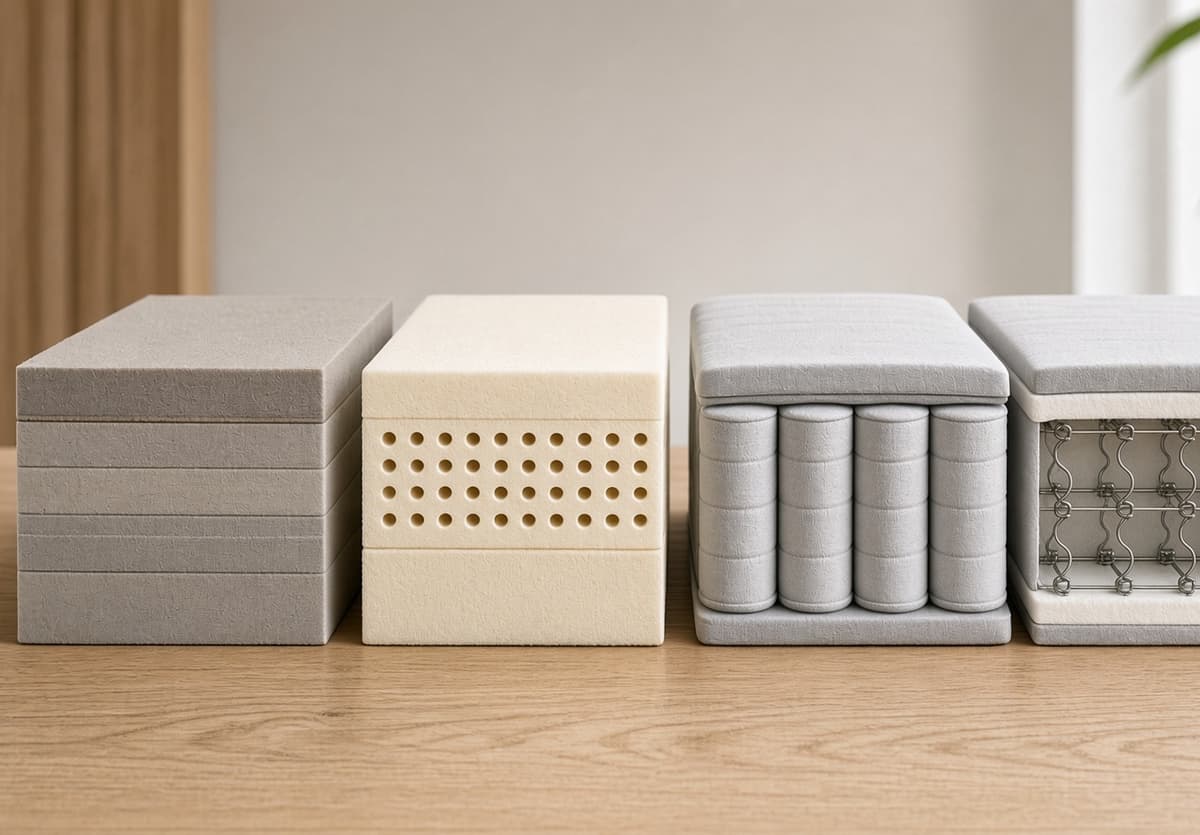
Side by side
| Memory foam | Natural latex | Pocket spring | Bonnell spring | |
|---|---|---|---|---|
| Feel | Slow sink, contour | Responsive, slight bounce | Lifted, local give | Uniform bounce |
| Cooling here | Poor unless air-conditioned | Good — open cells | Good — air between coils | Good — open unit |
| Motion isolation | Excellent | Good | Good | Poor |
| Getting up | Can feel stuck | Easy | Easy | Easy |
| Start here for | Air-conditioned rooms, couples, side sleepers | Hot rooms, back trouble, older sleepers | Couples who want bounce | Guest room, tight budget |
| Watch-outs | Heat, off-gassing when new | Weight, price, rare latex allergy | Coil count and the foam on top | Noise and sag as it ages |
These are starting points, not prescriptions. The mattress on the floor decides, not the table.
What we will not tell you: how long each one lasts
You will find tables online giving each construction a lifespan — foam six to nine years, latex twenty, and so on. We are not going to print one, because when we went looking for where those numbers come from, they come from people selling mattresses.
No consumer body publishes mattress life by type. The Better Sleep Council says a mattress set at seven years "has reached the end of the line". The National Bed Federation says seven to eight. Which? says eight to ten and applies it to memory foam, latex, pocket sprung and open coil alike. Consumer Reports declines to set a limit at all: if it is comfortable at twelve years, keep it.
Meanwhile latex retailers publish anything from fifteen to thirty. A spread that wide is not a measurement. It is a selling point.
What you can check is the warranty, because it is written down and somebody has to honour it. Read the structure rather than the headline number — most Indian mattress warranties are pro-rata after the first year or two, so a "ten-year warranty" may settle at a tenth of the value by year ten, and several brands charge you the transport. A warranty is a promise about sagging, not a promise about how long you will like the bed.
A short history of latex, and how it reached Indian bedrooms
Natural latex comes from the sap of Hevea brasiliensis, the rubber tree. The trick that turned sap into a mattress was the Dunlop process: in 1929 E. A. Murphy, working at Dunlop's latex laboratories in Birmingham, whipped latex with a kitchen mixer until it foamed, then poured it into a mould and vulcanised it so the bubbles stayed. The first latex mattress followed in 1931. That open structure is why latex moves air in a way a poured slab of memory foam does not.
In India the default bed for a long time was cotton. Cotton is familiar and cheap. It also holds dust, flattens, and does nothing particular for a hot sleeper. MM Foam say they have been making latex foam here since 1957, when that was still an unusual thing to put under a sheet — and before mattresses they were making luxury bus seats, aircraft seats and upholstery sheeting. The properties that keep a long-distance seat from collapsing are the ones that keep a mattress from turning into a hammock.
Their pincore construction is the visible part of that. MM Foam publish 8,840 pin cores of 6 mm through a single-size mattress. The pins are not decoration — they are how air gets in and out of a solid block of rubber, and they are how heat reaches the middle of the block during moulding.
What latex actually does well
It sleeps cooler than memory foam. Not because of a coating. Because the structure is open. In a Hyderabad bedroom without strong air conditioning, that is the argument that matters first.
It pushes back. Memory foam lets you sink and then holds you there. Latex gives and then returns. For anyone who changes position in the night — and for anyone who has to sit up and swing their legs out in the morning — that rebound is the difference between a bed you move on and a bed you climb out of.
It holds its shape. A well-made natural latex mattress, kept off damp walls and out of the sun, is the construction that most often outlives its warranty. MM Foam say some of their customers have used theirs for more than twenty-five years. Worth reading beside their own advice on the same range: they still recommend replacing a mattress after about ten years, for hygiene rather than for sagging. We would rather you had both halves of that.
What we are not going to claim. You will read that latex is hypoallergenic and resists dust mites and mould. Every source we could find for that sells latex. The research points elsewhere: mite allergen tracks humidity and the material of the top layer, not what the core is made of, and studies comparing water, spring and foam mattresses found similar allergen levels across all three. If allergy is the real reason you are shopping, the measure with actual trial evidence behind it is an allergen-proof encasement, and it costs a fraction of a mattress.
On mould, the honest version runs the other way: any mattress on a solid, unventilated platform in a humid climate can grow mould underneath it. Latex included. A slatted base is worth more here than any claim on a label.
One line about allergy, because it is real. Latex is rubber, and roughly one or two people in a hundred are allergic to natural rubber. If you already know that about yourself, say so before anybody unpacks a mattress.
Back trouble, and older sleepers
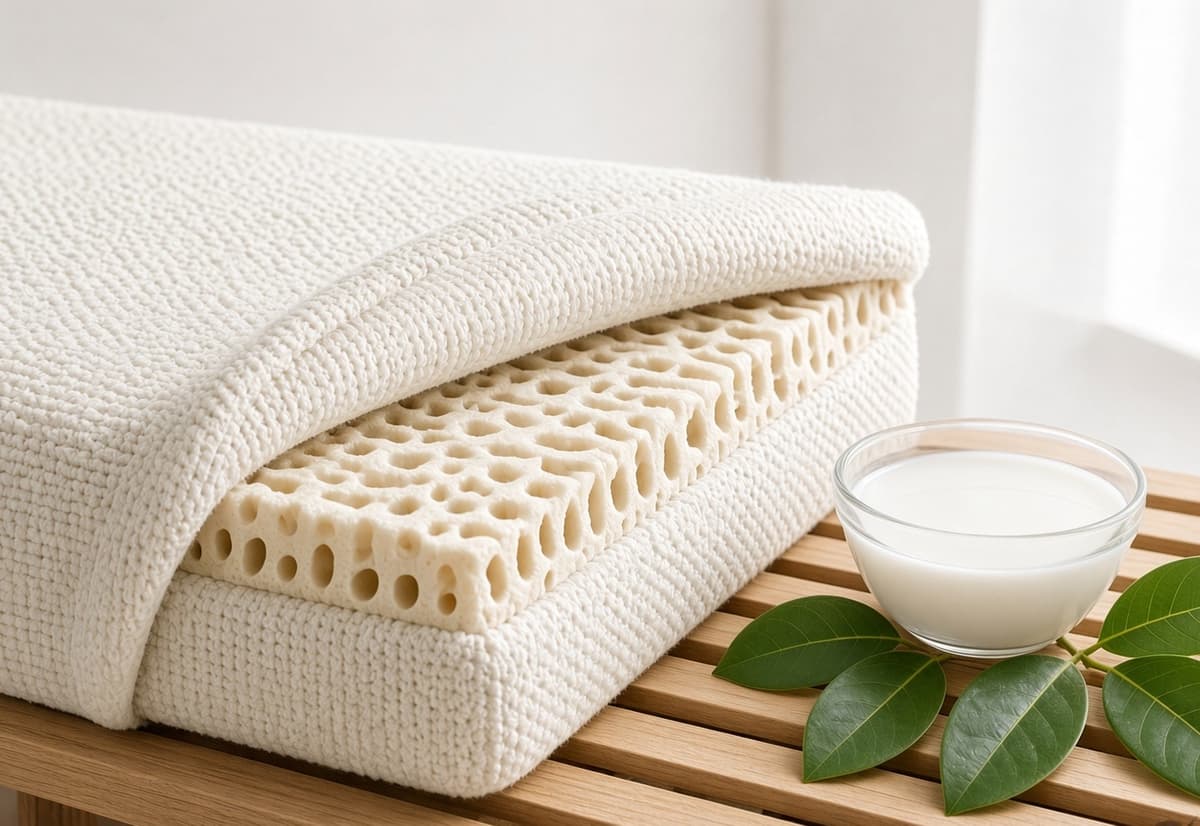
A mattress is not treatment. Nobody reputable should tell you latex will fix a spine. What we can tell you is what people with existing back trouble, and people who are getting older in the same bed, tend to choose once they have lain on all four.
Deep-sink memory foam can feel wonderful for the first five minutes and tiring after fifteen. The shoulders and hips drop; the lower back can hammock. Getting from a side position to sitting takes more effort than it looks. That effort is not theoretical if you are seventy, or if you have had a disc problem and do not want to wrestle the bed every morning.
Latex — particularly a firmer moulded block like Hardcore, or a support-led hybrid like Ortholex — keeps more of you on top of the mattress. The surface gives at the shoulder and hip without letting the waist collapse. You can roll. You can sit on the edge and stand up without the slow-motion climb. Pocket spring does some of the same work, which is why we still put people on a King Koil before letting them decide.
The rule we use on the floor:
- Side sleeper with shoulder pain, air-conditioned bedroom — try memory foam and a medium latex.
- Back sleeper, or anyone who already treats their back as a project — start on firmer latex and a zoned pocket spring, not the softest foam in the room.
- Older sleeper, or anyone who gets in and out of bed several times a night — latex or pocket spring. Avoid a deep memory-foam sink unless they try it for a full fifteen minutes and still want it.
- Two people who want different firmness — Dual Harmony, medium on one side and firm on the other, before you buy two mattresses.
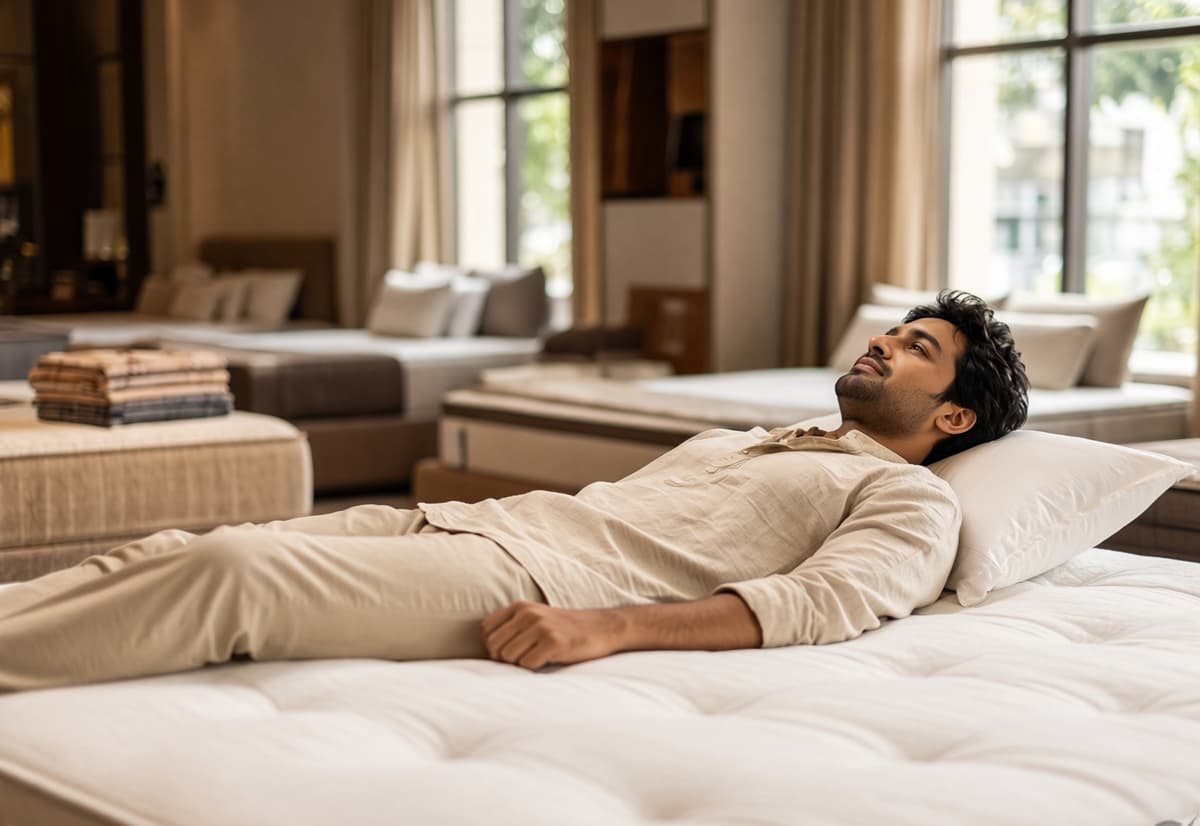
Lie the way you sleep. Sit on the edge. If you share the bed, test it together. The brochure will not do this part.

The four constructions in a Hyderabad house
Choose memory foam when the bedroom is air-conditioned most nights, when motion isolation is the main problem, and when the sleeper likes the slow contour. Ask what density the comfort layer actually is. A thin, cheap memory-foam quilt over a weak base is not the same product as a proper foam mattress.
Choose Bonnell for a guest room, a maid's room, or a budget single that will not be slept on every night. Do not spend pocket-spring money on a bed used six times a year, and do not put a Bonnell under two adults who are light sleepers.
Choose pocket spring when you want airflow and bounce, share the bed, and would rather not pay latex money — or when you have already decided you dislike the feel of rubber.
Choose latex when the room runs hot, when the mattress has to last, or when getting up matters as much as lying down. That is a large share of Hyderabad bedrooms.
Humidity is the other local variable, and it is where the usual instinct is wrong. A mattress against a damp outside wall will hold moisture whatever it is made of. But the standard answer here — put it out on the balcony in the sun — is the one thing you must not do to latex. Natural rubber degrades under ultraviolet: the sun cracks and embrittles it. If a latex mattress gets damp in the monsoon, blot it, stand it on its side in the shade with a fan on it, and put it back on a slatted base rather than a solid plywood box.
Why MM Foam, and why from here
We did not pick up the brand last season. The family shop in this city started in 1963 as Nagpals Foam Palace. MM Foam were already making latex when most beds here were still cotton. We took the range on early because the product that left the shop then was the product customers still mentioned ten and fifteen years later. That is a boring reason. It is also the only one that survives a long time in this trade.
MM Foam list us as their exclusive store in Hyderabad, which in practice means the whole line is on the floor rather than two display pieces. You can lie on Pincore and Hardcore in the same half hour, then walk three steps onto a pocket spring if the rubber is not what you thought you wanted. That comparison is the thing a single-brand shop cannot give you. We buy the mattresses from the manufacturer and sell them. We do not make them, and we will not say we do.
Where to start on the latex side:
- Pincore — moulded natural latex with pin-type cores. Seventeen years of warranty, against the ten MM Foam publish on most of the range. The default starting point for a Hyderabad bedroom without strong air conditioning.
- Hardcore — the same construction, considerably firmer. The one people with back trouble often stay on after they have tried the medium.
- Spineline — natural latex with an inner-core structure, support-led.
- Bloom — organic natural latex with very low motion transfer. For couples who like latex but hate bounce from the other side of the bed.
- Dual Harmony — medium on one side, firm on the other. The honest answer when two people want different things out of one bed.
- Ortholex — a firm latex hybrid built for spinal alignment. The one to look at when "orthopaedic" is the word that brought you in and you want to know what is actually inside.
Custom sizes are ordinary with MM Foam rather than a special order that takes a month and a prayer. Depending on the model the range starts at four, five or six inches; Multicore, Pincore, Hardcore and Dual Harmony go to twelve. Measure the frame inside edge to inside edge, in inches. Carpenter-made beds are the norm in this city, and a standard 78×72 that does not fit the box is a wasted Saturday.
The full range, with prices, is here.
What we would not tell you
We also carry Sleepwell, Peps, King Koil, Springfit and Centuary. If a pocket spring or a foam mattress is the better bed for that room, that is the bed. A latex mattress forced onto somebody who hates the bounce is a return waiting to happen.
Latex is heavier. Getting a twelve-inch king up a Banjara Hills stairwell is a planning problem, not a surprise. Check the lift, the landing and the door swing.
Price is not a personality. A cheaper mattress with no written return can be worth less than a costlier one you can send back. Compare the delivered price, not the sticker.
Come and lie on them. The showroom is House No 536, First Floor, Road No. 12, NBT Nagar, Banjara Hills, Monday to Saturday, 11am to 8.30pm. Mattresses are a different number from interiors: +91 95732 84811. Bring the size in inches, wear something you can lie down in, and do not buy the first mattress that feels better than the one you are replacing.
Still not sure? Send the size in inches on WhatsApp and we’ll tell you what we have in it. Or read more about mattresses.
This is the point where a measurement usually matters more than a preference. If you’d like us to look at it properly, start here.
Send the size in inches and we’ll tell you what we have in it.
Read next
- How to buy a mattress in Hyderabad
What to test, what to ask, and what to check on the bill before you pay. A buying guide for Hyderabad, from a showroom that carries six brands.
- Types of pillows — what they are for, and which ones we keep on the floor
Fill, shape and loft, in that order — and the eight MM Foam pillows on the floor in Banjara Hills, with the heights they publish.
NBT Nagar, Banjara Hills, Hyderabad 500034+91 96769 21216